

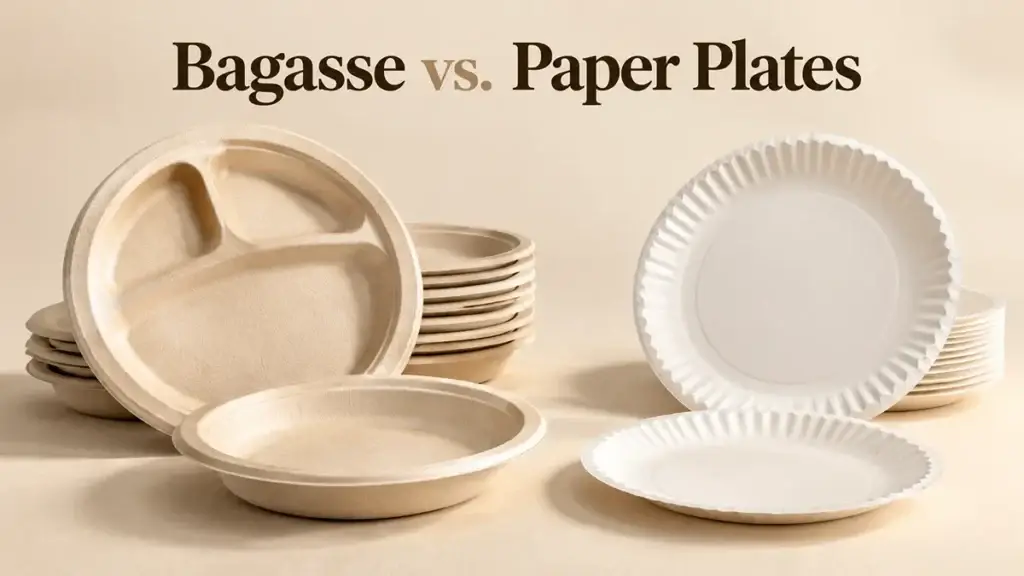
Choosing between bagasse and paper plates depends on the food being served, product performance, and purchasing costs. Bagasse plates are made from sugarcane fiber, while conventional paper plates are generally made from paper pulp. Both serve disposable foodservice needs, but their construction and suitability vary by product.
For restaurants, distributors, and private-label brands, the decision involves more than material choice. Durability, grease resistance, packaging, bulk pricing, and disposal requirements all affect purchasing decisions.
This guide compares bagasse vs. paper plates to help businesses choose the right option for their applications.
Key Takeaways
- Material: Bagasse plates use processed sugarcane fiber, while paper plates typically use paper pulp.
- Durability: Performance depends on product thickness, structure, and manufacturing quality.
- Grease Resistance: Both materials vary in performance depending on construction and surface treatments.
- Cost: Compare equivalent specifications, order quantities, packaging, and freight.
- Environmental Impact: Compostability and recyclability depend on the finished product and available waste-processing facilities.
- Best Choice: Select tableware based on food type, performance requirements, budget, and disposal options.
What Are Bagasse and Paper Plates?
Bagasse is the fibrous material left after sugarcane juice extraction. It can be processed into pulp and molded into plates, bowls, compartment trays, and takeaway containers. Molded construction allows manufacturers to produce defined shapes for different foodservice applications.
Paper plates are generally made from paper-based pulp and come in a range of sizes, thicknesses, and designs. Some use coatings or surface treatments to improve resistance to grease and moisture.
The main difference is the material and construction, but neither category has uniform performance. Fiber composition, thickness, shape, and additional treatments can all affect how a finished plate performs.
For more background, see our guide to what bagasse tableware is made of.
Bagasse vs. Paper Plates: Key Differences
For commercial buyers, the most useful comparison covers structural strength, grease resistance, cost, and disposal options.
| Factor | Bagasse Plates | Paper Plates |
|---|---|---|
| Material | Molded sugarcane fiber | Paper-based fiber |
| Structure | Molded shapes and compartments | Flat and formed designs |
| Durability | Depends on thickness, shape, and manufacturing quality | Depends on paper grade, thickness, and construction |
| Grease Resistance | Varies by product and treatment | Varies by product and coating |
| Cost | Depends on specifications, order volume, and packaging | Depends on specifications, coatings, and order volume |
| Disposal | Depends on product certification and local facilities | Depends on coatings, contamination, and local recycling rules |
Neither material is automatically better in every category. The right choice depends on the specific product and intended use.
Durability and Structural Strength
Bagasse plates can provide structural support through their molded shape and formed edges. Compartment designs may also help keep different foods separate.
Paper plates range from lightweight options for snacks to heavier constructions for full meals. A fair comparison should use products designed for similar serving requirements.
When evaluating durability, consider plate dimensions, thickness, intended load, and resistance to bending. Test samples with representative foods and serving times before approving a product for bulk purchasing.
Grease and Moisture Resistance
Grease and moisture resistance depend on the finished product’s construction, fiber characteristics, and any surface treatments.
Bagasse plates may suit meals containing sauces or oily foods, but their performance must be verified. Paper plates can also provide suitable resistance when designed for these applications.
Before placing an order, test samples with the intended foods. Check for softening, leakage, and loss of shape during normal use rather than relying on general material claims.
Cost and Bulk Purchasing
The cost comparison should use products with equivalent specifications. Size, weight, thickness, coatings, carton quantities, and order volume can all affect pricing.
For bulk orders, evaluate the total delivered cost rather than the unit price alone. Freight, packaging efficiency, minimum order quantities, and delivery arrangements can change the overall purchasing value.
A lower-priced plate may not be the better choice if it fails to meet operational requirements. Confirm specifications and sample performance before committing to a large order.
Environmental Impact and Disposal
Material origin alone does not determine the environmental impact of disposable tableware. Manufacturing, transportation, coatings, product construction, and end-of-life processing also matter.
Bagasse plates are made from sugarcane fiber, while paper plates use paper-based fibers. However, neither material should automatically be described as compostable or recyclable.
Buyers should verify applicable product certifications, check whether coatings affect disposal options, and confirm that local facilities accept the finished product. Requirements can differ by market, so environmental claims should be supported by documentation relevant to the product and destination.
What Are the Limitations of Bagasse and Paper Plates?
Both bagasse and paper plates have limitations. Their performance depends on product design, thickness, surface treatments, and intended use. Understanding these differences helps businesses select tableware that meets their foodservice requirements.
| Consideration | Bagasse Plates | Paper Plates |
|---|---|---|
| Structural Strength | Strength varies by thickness, shape, and molded design. | Lightweight designs may bend under heavier loads. |
| Grease and Moisture | Prolonged contact with hot, wet, or oily foods may affect performance. | Resistance depends on paper structure and any coatings or treatments. |
| Product Consistency | Different designs and specifications can produce different results. | Performance varies across paper grades, thicknesses, and constructions. |
| Disposal | Compostability depends on the finished product, certification, and local facilities. | Recyclability and compostability depend on coatings, food contamination, and local facilities. |
| Special Use Requirements | Microwave suitability must be confirmed by the manufacturer. | Heating suitability depends on the specific product and manufacturer instructions. |
Limitations of Bagasse Plates
When evaluating bagasse plates, buyers should pay particular attention to:
- Food performance: Some products may soften or lose rigidity during prolonged contact with hot, wet, or oily foods.
- Design differences: Plate thickness, shape, and compartment design can affect strength and usability.
- Disposal requirements: Not every bagasse plate is certified compostable, and local facilities may not accept every product.
- Heating instructions: Microwave suitability should be confirmed through the manufacturer’s instructions.
Limitations of Paper Plates
For paper plates, the main considerations include:
- Load capacity: Lightweight products may not provide sufficient support for heavier meals.
- Grease and liquid resistance: Performance depends on paper construction and any coatings or treatments.
- Disposal options: Coatings and food contamination may affect whether a plate can be recycled or composted.
For foodservice businesses, the best approach is to compare product specifications and test samples with the intended foods and serving conditions. Verify disposal requirements before making environmental claims, and confirm any special-use instructions before placing a bulk order.
Which Plates Work Best for Foodservice?
The best option depends on the menu, serving conditions, and operational priorities.
| Application | What to Consider |
|---|---|
| Hot meals and sauces | Structural support, moisture resistance, and handling |
| Fried or greasy foods | Verified grease resistance and contact time |
| Dry snacks and desserts | Basic strength, presentation, and unit cost |
| Catering and takeaway | Stackability, packaging, and transport |
| High-volume foodservice | Consistent specifications, supply continuity, and total cost |
Molded bagasse plates may suit complete meals and takeaway orders where defined shapes or compartments are useful. Paper plates may be appropriate for lighter foods or other applications where their construction meets the required performance.
For foodservice operators, sample testing under realistic conditions is more reliable than choosing based on material name alone.
How to Choose the Right Plates for Your Business
1. Confirm Product Requirements
Identify food types, portion sizes, serving conditions, and required plate dimensions. Determine whether the product needs to resist grease, support heavier meals, or separate different foods. These requirements help narrow the options before comparing prices.
2. Verify Specifications and Compliance
Request product specifications and relevant supporting documents. Depending on the market and application, these may include material details, dimensions, food-contact compliance documentation, and evidence supporting environmental claims. Confirm that the documentation applies to the exact product being purchased.
3. Evaluate Samples and Suppliers
Test samples before approving a bulk order. Check strength, leakage, packaging quality, and consistency against agreed specifications.
For distributors and private-label brands, also confirm customization options, carton configurations, production coordination, and delivery arrangements. These factors can be as important as the initial unit price.
Conclusion
Bagasse and paper plates serve different foodservice needs. Molded bagasse products may suit applications requiring defined shapes and structured serving formats, while paper plates offer options for lightweight and cost-sensitive uses.
The best purchasing decision comes from comparing verified product performance, equivalent specifications, total delivered cost, and available disposal options. Explore WVSCM’s sustainable tableware range to find products suited to your foodservice, distribution, or private-label requirements.
FAQs
Are Bagasse Plates Stronger Than Paper Plates?
Bagasse plates often provide good structural support because they are molded into shape. However, strength varies by thickness, design, and manufacturing quality. Compare products intended for the same food and serving conditions, and test samples before placing a bulk order.
Are Bagasse Plates More Expensive Than Paper Plates?
Bagasse plates may cost more per unit than basic paper plates, but prices vary by size, weight, construction, order volume, and packaging. For bulk purchasing, compare equivalent specifications and total delivered cost, including freight, rather than unit price alone.
Are Bagasse Plates Compostable?
Bagasse plates can be commercially compostable, but this depends on the finished product, applicable certification, and local facility requirements. Buyers should verify product-specific documentation and confirm that their composting provider accepts the plates before making compostability claims.
Are Paper Plates Compostable or Recyclable?
It depends on the plate’s construction and local waste management rules. Coatings and food contamination can affect whether paper plates are accepted for composting or recycling. Check the product specifications and local facility guidelines before choosing a disposal method.
Are Bagasse Plates Microwave-Safe?
Some bagasse plates are suitable for microwave reheating, but this should not be assumed for every product. Check the manufacturer’s instructions for the specific plate, including any temperature or time limits. Compostability or sugarcane-fiber content alone does not establish microwave safety.
Do bagasse plates contain PFAS or plastic coatings?
Uncoated molded bagasse plates rely on fiber density for grease resistance and generally contain no PFAS or plastic coatings, but formulations vary by manufacturer. Buyers should request PFAS-free documentation and coating declarations for the specific product before ordering.
Let's discuss your product requirements.
Share your product brief, estimated quantity and target timeline with WVSCM.
Request a Quote