

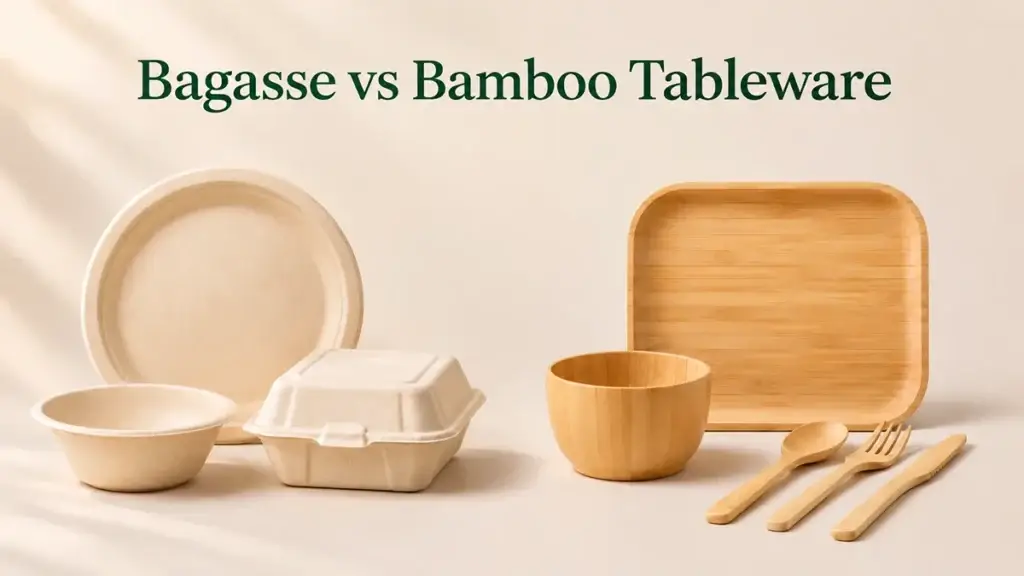
Which is the better choice for foodservice and wholesale sourcing: bagasse or bamboo tableware? The answer depends on the product—not simply on whether the raw material is plant-based.
Bagasse is commonly molded into plates, bowls, and takeaway containers. Bamboo tableware is a broader category that includes solid bamboo cutlery, molded bamboo-pulp products, and composite items. These products differ in construction, performance requirements, and material composition.
For importers, distributors, and foodservice buyers, a useful bagasse vs bamboo comparison starts with the finished product: its intended use, specifications, food-contact documentation, packaging, and total landed cost. This guide explains the key differences and what to check before placing a wholesale order.
Key Takeaways
- Bagasse is commonly used for molded plates, bowls, trays, and takeaway containers.
- Bamboo tableware includes several distinct categories, such as solid bamboo products, cutlery, bamboo pulp items, and composites.
- Product performance depends on material composition, manufacturing methods, product geometry, and finishing.
- Wholesale costs should be compared using equivalent specifications and should include packaging and freight.
- Food-contact suitability and compostability must be verified for the complete finished product.
What Is the Difference Between Bagasse and Bamboo Tableware?
The main difference starts with the raw material and how it is processed. Although both originate from plants, their manufacturing routes and common product applications are different.
What Is Bagasse Tableware?
Bagasse tableware is made from the fibrous residue left after sugarcane juice extraction. The fibers are processed into molded products for foodservice and takeaway applications.
Common applications include:
- Disposable plates and compartment plates
- Food bowls and serving trays
- Takeaway containers and food packaging
The typical production process involves fiber preparation, pulping, molding, and drying. Finished-product consistency can be affected by several factors:
- Pulp composition and fiber quality
- Mold design and product geometry
- Wall thickness and product density
- Surface treatments and any additional materials
For buyers developing a coordinated foodservice range, molded bagasse can offer different plate shapes, bowl capacities, and compartment configurations when suitable molds are available.
What Is Bamboo Tableware?
Bamboo tableware is a broad product category, not one material specification or manufacturing process. Depending on the product, bamboo may be cut, shaped, processed into fibers, or combined with other materials.
| Bamboo Product Type | Manufacturing Method | Common Applications |
|---|---|---|
| Solid bamboo tableware | Cutting, shaping, and machining | Serving products, plates, and accessories |
| Bamboo cutlery | Cutting and shaping processed bamboo | Forks, knives, spoons, and chopsticks |
| Bamboo pulp tableware | Fiber processing and molding | Plates, bowls, and trays |
| Bamboo composite products | Combining bamboo powder or fibers with other materials | Selected reusable or molded products |
These categories should not be treated as interchangeable. A solid bamboo fork has a different structure and manufacturing process from a molded bamboo-pulp plate.
Before comparing quotations or making performance claims, procurement teams should confirm the actual material composition and production method.
Understanding Different Types of Bamboo Tableware
The term bamboo tableware can refer to several distinct product categories. Identifying the specific type helps buyers compare products that serve similar purposes.
Solid Bamboo and Bamboo Sheath Products
Solid bamboo products are made by cutting, shaping, or machining bamboo into finished items. Bamboo sheath products use the outer protective layers of bamboo in certain pressed or molded applications.
Relevant purchasing specifications include:
- Material thickness and structural consistency
- Edge finishing and surface smoothness
- Product dimensions and manufacturing tolerances
- Finishing treatments and material composition
Bamboo Cutlery
Bamboo cutlery includes forks, knives, spoons, and chopsticks. It is commonly used in takeaway packaging, catering, restaurants, and foodservice supply programs.
| Evaluation Factor | What Buyers Should Check |
|---|---|
| Surface finish | Smooth surfaces and properly finished edges |
| Dimensions | Consistent length, width, and proportions |
| Structural integrity | Suitable strength for the intended use |
| Appearance | Consistent color and workmanship |
| Packaging | Individual wrapping, bulk packs, or retail sets |
For distributors, consistency across production batches matters. Variations in dimensions, finishing, or surface quality can affect the presentation of an entire retail or foodservice range.
Bamboo Pulp and Composite Tableware
Bamboo-pulp tableware is made by processing bamboo fibers into pulp and forming them into products such as plates, bowls, and trays. Bamboo composite tableware is different: it may combine bamboo powder or fibers with binders, resins, or other materials.
This distinction matters when evaluating food-contact compliance, finished-product composition, structural properties, recyclability, and compostability. Buyers should request a complete material declaration rather than relying on broad descriptions such as bamboo-based or natural tableware.
Bagasse vs Bamboo Plates: Key Product Differences
Bagasse plates and bamboo plates may serve similar foodservice applications, but their manufacturing methods and finished structures can vary. The comparison below is a starting point; buyers should confirm the exact product type before assessing performance or price.
| Comparison | Bagasse Tableware | Bamboo Tableware |
|---|---|---|
| Raw material | Sugarcane fiber residue | Bamboo stalks, sheaths, or processed fibers |
| Common products | Plates, bowls, trays, and containers | Cutlery, plates, bowls, and trays |
| Manufacturing | Primarily molded-fiber production | Cutting, shaping, pressing, or molding |
| Product structure | Molded-fiber construction | Depends on the product category |
| Surface finish | Depends on pulp and molding process | Depends on material and finishing |
| Customization | Shapes, sizes, compartments, and packaging | Product design, dimensions, configurations, and packaging |
| Cost factors | Product weight, molding, tooling, and order volume | Processing, product structure, labor, and order volume |
| Compostability | Must be verified for the finished product | Must be verified for the finished product |
A molded bamboo-pulp plate is generally a more relevant comparison with a bagasse plate than a solid bamboo serving product or bamboo fork.
For a fair supplier comparison, check:
- Equivalent product dimensions and capacity
- Similar weight and structural requirements
- Intended food type and serving duration
- Surface treatments and additional materials
- Packaging quantity and carton configuration
Comparing equivalent specifications provides a more reliable basis for evaluating product quality and purchasing costs than comparing product names alone.
How Do Bagasse and Bamboo Tableware Perform in Foodservice?
The suitability of disposable tableware depends on the food being served, contact time, and product construction. Temperature, moisture, oil content, and food weight should all be considered when evaluating samples.
Hot and Greasy Foods
Hot meals and oily foods require suitable structural stability and resistance under the intended serving conditions. Bagasse plates are commonly used for molded foodservice applications, but their performance varies with product density, thickness, construction, and surface treatment.
Bamboo products also vary by category. A solid bamboo item, a bamboo-pulp plate, and a bamboo composite product should not be expected to perform in the same way.
When testing samples, buyers should check:
- Whether the product maintains its shape during the intended serving period
- Whether oil penetrates or visibly affects the surface
- Whether the base remains stable under the expected food load
- Whether coatings or treatments affect the material composition
Wet Foods and Takeaway Meals
Soups, sauces, and other liquid-rich foods place additional demands on plates and containers. A product suitable for dry food may not perform equally well during extended contact with moisture.
| Test Consideration | What to Evaluate |
|---|---|
| Liquid resistance | Whether liquid penetrates the product |
| Structural stability | Whether the product softens or deforms |
| Load capacity | Whether the base remains stable under the expected load |
| Serving duration | Whether performance is maintained for the intended use period |
| Surface treatment | Whether coatings or additives affect the finished product |
For takeaway applications, packaging configuration also matters. Products need to remain suitable throughout filling, stacking, transportation, and customer use.
Bamboo Cutlery and Foodservice Sets
Bamboo cutlery serves a different purpose from molded bagasse plates and containers. Its suitability should be evaluated through:
- Smoothness and edge finishing
- Dimensions and handling comfort
- Structural integrity during normal use
- Consistency across production batches
For distributors supplying takeaway sets, bamboo cutlery can complement molded-fiber plates and containers as part of a coordinated product assortment.
Bagasse vs Bamboo: Cost and Wholesale Considerations
For importers and distributors, comparing bagasse and bamboo tableware requires more than checking the quoted unit price. Manufacturing methods, product specifications, minimum order quantities, and shipping arrangements all contribute to the final purchasing cost.
The following factors should be reviewed when comparing wholesale suppliers.
Manufacturing and Material Processing
Production requirements vary by material and product type:
- Bagasse tableware: Requires fiber preparation, pulping, molding, and drying.
- Bamboo products: May involve cutting, machining, shaping, pressing, or pulp molding.
The complexity of the manufacturing process and finished design can influence production costs.
Product Specifications
Two products with similar dimensions may have different material consumption and manufacturing requirements. Before comparing quotations, confirm:
- Product dimensions, thickness, and weight
- Structural design and material composition
- Surface treatments or additional coatings
- Custom shapes, compartments, or configurations
Comparisons based on equivalent specifications provide a more reliable indication of supplier pricing.
MOQ and Customization Costs
Minimum order quantities (MOQs) depend on the product category, production arrangements, and customization requirements. Additional considerations may include:
- Custom molds or tooling
- Product design modifications
- Printed or private-label packaging
- Production setup and artwork preparation
For new product launches, buyers should confirm these requirements early to avoid unexpected costs or delays.
Packaging and Transportation
Packaging affects both product protection and shipping efficiency. Carton dimensions, packing quantities, and stacking arrangements can influence the total shipment volume.
When requesting quotations, confirm:
- Units per inner pack and export carton
- Carton dimensions and gross weight
- Palletization requirements, if applicable
- Shipping terms and estimated freight costs
How to Calculate the Total Landed Cost
A lower factory quotation does not always translate into a lower purchasing cost. For wholesale procurement, consider the complete cost structure:
Total Landed Cost = Product Cost + Packaging + Freight + Other Applicable Costs
For businesses sourcing bagasse tableware wholesale or bamboo cutlery wholesale, comparing these cost components helps identify suppliers that offer better overall purchasing value—not simply the lowest unit price.
Which Is More Sustainable: Bagasse or Bamboo?
Both bagasse and bamboo come from renewable plant resources, but their environmental profiles depend on raw material sourcing, manufacturing, product composition, and disposal conditions.
| Sustainability Factor | Bagasse | Bamboo |
|---|---|---|
| Raw material | Sugarcane processing residue | Bamboo stalks, sheaths, or fibers |
| Manufacturing | Pulping, molding, and drying | Cutting, machining, pulping, or molding |
| Additional materials | May contain coatings or additives | May contain coatings, binders, or resins |
| Compostability | Depends on the finished product | Depends on the finished product |
| Verification | Product-specific documentation | Product-specific documentation |
What Should Buyers Verify?
- Material composition: Identify all fibers, coatings, binders, and additives.
- Manufacturing information: Understand the main processing methods.
- Certification scope: Confirm whether certification covers the complete finished product.
- Disposal requirements: Distinguish industrial composting from home composting.
A plant-based product is not automatically compostable. Claims such as biodegradable, industrially compostable, and home compostable should be supported by appropriate product-specific evidence.
What Should Wholesale Buyers Check Before Ordering?
Selecting a suitable material is only the first step. Importers and distributors should also verify product specifications, compliance documents, customization capabilities, and production consistency before placing bulk orders.
Product Specifications and Sample Evaluation
Request a detailed specification sheet covering:
| Specification | Information to Confirm |
|---|---|
| Material | Fiber composition, coatings, binders, and additives |
| Dimensions | Length, width, diameter, and height |
| Thickness and weight | Actual measurements and tolerances |
| Product structure | Shape, capacity, and compartments |
| Surface finish | Texture and finishing treatments |
| Packaging | Units per pack and carton dimensions |
Samples should be tested under realistic serving conditions rather than evaluated by appearance alone. A buyer sourcing molded plates for takeaway meals, for example, should test them with representative foods and for the expected serving period.
Food-Contact Compliance and Certifications
Documentation requirements depend on the destination market and finished-product composition. Buyers should identify applicable requirements and request relevant supporting documents, such as:
- Material declarations
- Applicable food-contact test reports
- Market-specific compliance documentation
- Compostability certificates, where applicable
Check the certificate holder, applicable standard, product coverage, and whether the complete finished product is included. A certificate for a raw material or component should not automatically be treated as certification of the finished tableware.
OEM, Packaging, and Supply Consistency
For private-label programs, confirm the following before production:
- Custom dimensions, shapes, and configurations
- Logo printing and retail packaging
- Carton specifications and labeling
- MOQ and production lead times
- Quality control and batch consistency
Clear specifications and approved samples help reduce revisions during mass production and improve purchasing coordination.
Which Material Should Your Business Choose?
There is no universal winner in the bagasse vs bamboo comparison. The right choice depends on product format, intended application, and purchasing requirements.
| Business Requirement | Product Direction to Evaluate |
|---|---|
| Molded plates and compartment plates | Bagasse tableware |
| Food bowls and takeaway containers | Bagasse or suitable bamboo-pulp products |
| Disposable forks, knives, and spoons | Bamboo cutlery |
| Molded-fiber product ranges | Bagasse and bamboo-pulp tableware |
| Private-label product development | Evaluate customization, MOQ, packaging, and supply consistency |
For importers and distributors, a clear product specification is a better starting point than choosing a material based on broad marketing claims. Match the finished product to its intended application and verify supplier specifications before placing a bulk order.
Conclusion
Bagasse and bamboo serve different roles across the disposable tableware market. Bagasse is widely used for molded plates, bowls, and food containers, while bamboo covers a broader range of products, including cutlery, solid tableware, pulp-based items, and composites.
For wholesale buyers, the decision should be based on finished-product specifications, foodservice requirements, compliance, and total purchasing cost.
FAQs
What is the difference between bagasse and bamboo tableware?
Bagasse tableware is generally made from molded sugarcane fibers. Bamboo tableware includes solid bamboo products, cutlery, molded bamboo-pulp items, and composites. Their manufacturing processes and finished-product properties differ.
Is bagasse tableware better than bamboo tableware?
Neither is universally better. Bagasse is commonly used for molded plates and containers, while bamboo serves different product formats. Buyers should compare finished products against their intended applications.
Are bamboo plates compostable?
Not all bamboo plates are compostable. Their suitability depends on material composition, coatings, binders, manufacturing processes, and whether the finished product has relevant compostability certification.
Are bagasse plates suitable for hot food?
Bagasse plates are used for many hot-food applications, but suitability depends on product specifications. Buyers should verify temperature limits, structural stability, and performance through manufacturer documentation and sample testing.
Which is more cost-effective, bagasse or bamboo tableware?
Cost depends on product design, weight, manufacturing, order quantity, packaging, and freight. Comparing total landed costs for products with equivalent specifications gives buyers a more reliable result.
Let's discuss your product requirements.
Share your product brief, estimated quantity and target timeline with WVSCM.
Request a Quote