

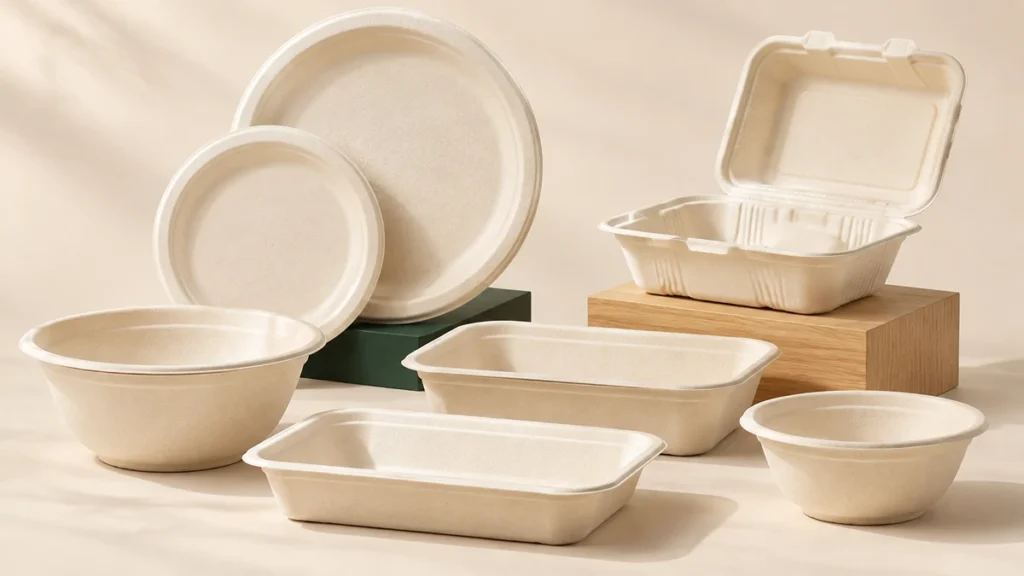
Bagasse tableware safety depends on the finished product’s composition, additives, and intended food-contact conditions. Made primarily from sugarcane fiber, bagasse tableware is widely used for disposable plates, bowls, trays, and takeaway containers. However, a plant-based material is not automatically food-safe.
For food-contact use, the finished article must be evaluated against the substances it contains and the conditions in which it will be used. US buyers should review applicable FDA food-contact requirements, PFAS and other chemical testing where relevant, and product-specific supplier documentation before approving a product.
Key Takeaways
- Food-contact suitability depends on the complete finished product, not simply its sugarcane-fiber content.
- FDA compliance is assessed through the regulatory status of the substances used and their intended conditions of use; there is no universal FDA approval certificate for all bagasse tableware.
- PFAS, coatings, additives, and other potential chemical concerns should be evaluated through relevant product-specific evidence.
- Test reports should identify the sample, analytical scope, test methods, conditions, and reporting limits.
- Material declarations, product specifications, and quality records help buyers check whether the tested product matches the item being purchased.
Is Bagasse Tableware Safe for Food Contact?
Bagasse can be used to manufacture food-contact tableware, but the suitability of a finished product depends on more than its fiber source. The complete formulation, manufacturing inputs, surface treatments, and intended application all matter. A plate used briefly for dry food has a different use profile from a container holding hot, oily food during delivery.
Material Composition
Bagasse tableware is primarily made from processed sugarcane fiber. Depending on the product design and performance requirements, the formulation may also include processing aids, functional additives, or surface treatments. These additional components should be considered because the finished article—not the raw fiber in isolation—is what contacts food.
Additives and Surface Treatments
Treatments may be used to improve moisture resistance, grease resistance, or other functional properties. Their suitability depends on the substances involved, their purpose, and the applicable food-contact requirements. Buyers should request a material declaration that identifies relevant fibers, additives, coatings, and other components.
Intended Food-Contact Conditions
The product specification and supporting evaluation should reflect the actual application.
| Factor | What Buyers Should Confirm |
|---|---|
| Food type | Dry, aqueous, acidic, or fatty foods |
| Temperature | Hot-fill, reheating, warm serving, or cold-food use |
| Contact duration | Brief serving contact or longer food storage and delivery |
| Product composition | Fiber, additives, coatings, and other components |
| Intended application | Dine-in, takeaway, delivery, or retail food packaging |
For example, a plate used to serve dry food briefly may not require the same performance profile as a takeaway container holding hot, oily food. Confirm that the supplier’s specifications and test conditions match the intended use.
Does Bagasse Tableware Need FDA Approval?
There is no universal FDA approval certificate covering all bagasse tableware. In the United States, food-contact compliance depends on the regulatory status of the substances used in the finished product and the conditions under which they are intended to contact food.
The FDA regulates food-contact substances through several pathways, including applicable food additive regulations, Generally Recognized as Safe (GRAS) provisions, prior sanctions, Threshold of Regulation exemptions, and Food Contact Substance Notifications (FCNs). The appropriate basis depends on the substance and its intended use.
How FDA Regulates Food-Contact Materials
Under the Federal Food, Drug, and Cosmetic Act, substances that migrate into food from packaging and other food-contact materials may fall within the food-additive framework. A relevant regulatory basis must support the intended use. A supplier’s general statement that a product is “FDA compliant” is therefore not enough by itself; buyers should ask which substances and conditions of use are covered.
An effective Food Contact Substance Notification is also subject to its stated scope. Buyers should not assume that an authorization associated with one manufacturer or supplier automatically applies to another source or to a different formulation.
Which FDA Regulations May Apply?
| Regulation | General Scope |
|---|---|
| 21 CFR Part 174 | General provisions for indirect food additives |
| 21 CFR Part 175 | Adhesives and components of coatings |
| 21 CFR Part 176 | Paper and paperboard components |
| 21 CFR Part 177 | Polymers |
| 21 CFR Part 178 | Adjuvants, production aids, and sanitizers |
These provisions are not a checklist that automatically applies in full to every molded bagasse product. The relevant requirements depend on the actual composition, construction, components, and intended conditions of use. For example, Part 176 addresses certain substances used in paper and paperboard applications, but the applicability of a specific provision should be assessed for the product in question.
What Should US Buyers Verify?
- Material composition: Which fibers, additives, coatings, and other components are used?
- Regulatory basis: Which applicable FDA provision or authorization supports the intended use?
- Conditions of use: Are food types, temperatures, and contact durations within the supported conditions?
- Supporting evidence: Are declarations and test reports available for the specific finished product?
Reference: FDA guidance, “Determining the Regulatory Status of Components of a Food Contact Material.” Add the current FDA URL as an external link during publishing.
Are There PFAS in Bagasse Tableware?
PFAS are a large group of synthetic chemicals valued for properties such as resistance to grease, oil, water, and heat. Certain PFAS have historically been used in food packaging to provide grease resistance. A product’s plant-based fiber content does not establish whether PFAS are present; the answer depends on its formulation, processing inputs, and any functional treatments.
Why PFAS Matter in Food Packaging
PFAS have drawn attention because of their persistence and potential exposure through food-contact materials. Some paper-based packaging historically used PFAS-containing grease-proofing agents. The FDA announced in February 2024 that PFAS-containing grease-proofing substances were no longer being sold by manufacturers for food-contact use in the US market. In January 2025, the FDA announced that 35 related Food Contact Notifications were no longer effective following the abandonment of those uses.
Those developments concerned certain PFAS-containing grease-proofing uses in paper and paperboard food packaging. They should not be described as a blanket prohibition covering every PFAS substance or every food-contact application. Buyers should assess the actual formulation and the scope of the evidence supplied.
How to Verify PFAS-Free Claims
A PFAS-free claim should be supported by testing that identifies the finished product and explains what the laboratory analyzed. Two common approaches provide different information:
| Testing Approach | What It Indicates | Important Limitation |
|---|---|---|
| Total fluorine screening | Screens for total fluorine in the tested sample and may be used as an initial indicator. | Does not identify individual PFAS compounds or prove that all PFAS are absent. |
| Targeted PFAS analysis | Measures the specific PFAS compounds included in the analytical method. | Does not cover every possible PFAS substance; the analyte list must be reviewed. |
When reviewing a report, check the sample identification, analytes, analytical method, detection or reporting limits, laboratory details, report number, and test date. “Not detected” means the substances included in the test were not detected above the stated reporting limits; it does not establish absolute absence of every PFAS compound.
Reference: FDA information on authorized uses of PFAS in food-contact applications. Verify the latest FDA page and regulatory status before publication.
Can Bagasse Tableware Contain BPA or Lead?
BPA and lead should not be assumed to be present in bagasse tableware, but neither should their absence be inferred from the word “plant-based.” The relevant question is whether the finished product or any of its components introduce substances that require evaluation under the applicable food-contact or customer testing requirements.
BPA and Other Bisphenols
BPA is commonly associated with certain plastics and resin systems; it is not an inherent component of sugarcane fiber. However, buyers should assess the complete formulation, including any coatings, inks, adhesives, or other components that may be used in a particular product. If BPA or broader bisphenol screening is a customer requirement, confirm the exact analytes and test scope with the laboratory.
Lead and Other Heavy Metals
Heavy-metal analysis may form part of a product’s chemical safety assessment depending on its composition, market requirements, and customer specifications. The relevant elements, methods, and acceptance criteria should be established before testing. A report should identify the tested sample and the specific elements analyzed; a generic statement that a product is “heavy-metal free” is not a substitute for defined test evidence.
Can Bagasse Tableware Release Microplastics?
Bagasse fiber itself is a plant-derived material, but the term “bagasse tableware” does not describe every additive or surface treatment that may be present in a finished product. Some products may use coatings or other components to achieve particular performance characteristics. Buyers should therefore review the full material declaration rather than assume that every product is entirely fiber-only.
If a buyer has a specific concern about plastic components or microplastic release, the test plan should be defined with a qualified laboratory around the actual product construction and intended use. Do not treat a general food-contact report, a PFAS report, or a compostability certificate as proof that a product has been evaluated for microplastic release.
What Tests Are Needed for Bagasse Tableware?
The appropriate testing program depends on the product’s composition, intended food-contact conditions, destination market, and customer requirements. Plates, bowls, trays, and takeaway containers may need different evaluations because their structures and applications are not identical. It is useful to distinguish chemical-safety testing from physical-performance testing.
Food-Contact Safety Testing
Migration testing evaluates whether substances from a food-contact material can transfer into food or an appropriate food simulant under specified conditions. The test design should reflect relevant factors such as food type, temperature, contact duration, and the material being evaluated. Testing the finished article is particularly important because raw-material results may not represent a product that includes additional components or surface treatments.
Heavy-metal analysis and PFAS testing may also be appropriate depending on the product formulation, regulatory assessment, and customer specification. There is no single universal test package that automatically applies to every bagasse product.
Product Performance Testing
Performance testing helps determine whether tableware can withstand expected foodservice conditions. The tests selected should correspond to the intended product and application.
| Test | What It Evaluates |
|---|---|
| Water resistance | Performance during moisture exposure |
| Oil resistance | Resistance to grease and fatty foods |
| Leakage testing | Liquid retention under specified conditions |
| Structural testing | Resistance to bending, deformation, or loss of shape |
| Temperature testing | Suitability under specified temperature conditions |
A container designed for hot takeaway meals may need different performance evaluations from a plate intended for short-term serving. Agree on test conditions and acceptance criteria before production so that sample evaluation provides a consistent reference for later batches.
What Documents Should Buyers Request?
Useful documentation should relate directly to the product being purchased. General certificates and marketing claims provide background, but they do not replace evidence for the finished product.
| Document | What It Helps Verify | What Buyers Should Check |
|---|---|---|
| Material declaration | Product composition | Fiber, additives, coatings, and other relevant components |
| Food-contact test report | Results of specified food-contact testing | Product identity, test methods, conditions, and results |
| PFAS test report | Results of specified PFAS analysis | Analytes, method, detection limits, and reporting language |
| Compliance declaration | Supplier’s stated regulatory basis | Applicable provisions and intended conditions of use |
| Product specification sheet | Product construction and intended application | Dimensions, weight, design, and use conditions |
| Quality inspection records | Manufacturing inspection activities | Inspection procedures, batch identification, and consistency |
Do Certifications Prove Food-Contact Safety?
Not all certifications address the same requirements. Buyers should distinguish product-specific food-contact evidence from environmental certifications and management-system certifications.
| Document or Certification | What It Addresses | What It Does Not Establish |
|---|---|---|
| Food-contact documentation | Applicable food-contact requirements for the product and intended use | Universal FDA approval of every item from a supplier |
| Compostability certification | Specified compostability criteria under its certification scope | Food-contact safety or chemical migration compliance |
| ISO 9001 | Quality management system | Food safety approval of an individual product |
| ISO 22000 | Food safety management system | Universal product-level food-contact approval |
Check the issuing organization, certification scope, validity period, and covered products or operations. A certificate shown on a supplier’s website should not be assumed to cover every product in its catalog.
How to Choose a Bagasse Tableware Supplier
A capable supplier should be able to explain the product specification, identify the documentation available for the finished item, and maintain agreed quality requirements across production runs. For importers, wholesalers, and private-label brands, the evaluation should cover both compliance evidence and the supplier’s ability to reproduce the approved product.
- Request a product-specific material declaration and confirm whether coatings or functional treatments are used.
- Review test reports for product identity, test scope, methods, conditions, and reporting limits.
- Confirm that the regulatory basis matches the intended food types, temperatures, and contact duration.
- Agree on dimensions, product weight, appearance, packaging, inspection criteria, and acceptable tolerances.
- Establish sample approval, change-control, batch traceability, and documentation requirements before mass production.
For customized orders, changes to the formulation, surface treatment, product construction, or intended use may affect the relevance of existing test reports. Review these changes before approving production rather than assuming earlier documents remain applicable.
WVSCM supports sustainable tableware sourcing, product development, and OEM customization. Buyers can review our sustainable tableware solutions and share their product specifications to discuss sourcing requirements.
Conclusion
Bagasse tableware can be suitable for food contact when the finished product’s composition, manufacturing inputs, and intended conditions of use meet applicable requirements. Its plant-based origin alone does not establish food-contact safety.
For US buyers, the practical approach is to review the regulatory basis, product-specific testing, material declarations, and manufacturing controls together. These checks help importers and private-label brands make better-informed sourcing decisions and confirm that the product supplied matches the approved specification.
FAQs
Is bagasse tableware safe for hot food?
It can be designed for hot-food applications, but suitability depends on the finished product’s composition, construction, and tested temperature conditions. Check the manufacturer’s specifications and evaluate samples under realistic serving conditions.
Is bagasse tableware FDA approved?
There is no universal FDA approval certificate for all bagasse tableware. Compliance depends on the regulatory status of the substances used and their intended food-contact conditions. Ask for the applicable regulatory basis and supporting product documentation.
Is bagasse tableware PFAS-free?
Not automatically. Sugarcane fiber content alone does not establish whether PFAS are present. Review relevant finished-product test reports, including the analytes, methods, and reporting limits.
Does bagasse tableware contain BPA?
BPA is not an inherent component of sugarcane fiber. However, buyers should review the full formulation and any coatings or other components. If BPA screening is required, specify the analytes and test scope.
Can bagasse tableware contain lead?
Lead is not an inherent feature of bagasse fiber. Where required by the product specification or market assessment, request a heavy-metal report that identifies the tested product, elements analyzed, method, and results.
Let's discuss your product requirements.
Share your product brief, estimated quantity and target timeline with WVSCM.
Request a Quote