

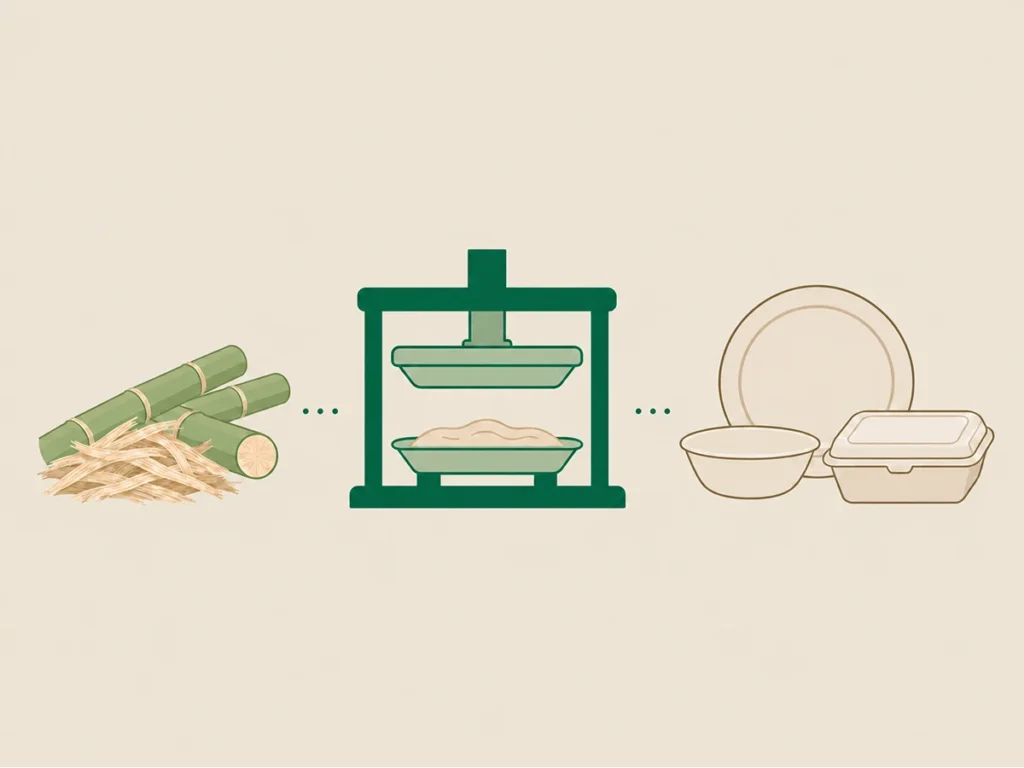
Bagasse tableware is manufactured by converting the fibrous residue from sugarcane juice extraction into molded-fiber products. The process typically involves raw material preparation, pulping, fiber conditioning, molding, drying, trimming, and quality inspection.
After sugarcane juice is extracted, the remaining fibers are cleaned and processed into pulp. The pulp is then formed into plates, bowls, trays, and food containers using specialized molds. Depending on the production method, vacuum forming, heat, and pressure are used to establish the product’s shape and structure.
For importers and distributors, understanding how bagasse tableware is made provides useful insight into manufacturing capabilities, product consistency, and the specifications that matter when evaluating suppliers.
Key Takeaways
- Bagasse is the fibrous residue left after sugarcane juice extraction.
- The fibers are prepared and processed into pulp or another suitable forming material.
- Molding, heat, and pressure establish the shape and structure of tableware.
- Drying, trimming, and inspection prepare finished products for packaging and distribution.
Where Does Sugarcane Bagasse Come From?
Sugarcane bagasse is the fibrous material left behind after sugarcane stalks are crushed to extract juice. Rather than being part of the extracted juice, these fibers remain as a byproduct of sugar processing and can serve as raw material for molded-fiber manufacturing.
The quality of bagasse entering production depends partly on the condition of the sugarcane and the juice extraction process. Fiber composition, residual pith, moisture, and contamination can all influence subsequent processing.
From Sugarcane to Bagasse
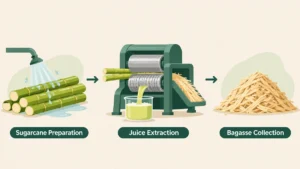
Bagasse is generated during the mechanical extraction of sugarcane juice. The process generally involves three stages:
- Sugarcane preparation: Harvested stalks are cleaned and prepared for processing.
- Juice extraction: Crushing rollers or other extraction equipment separate the juice from the fibrous stalk material.
- Bagasse collection: The remaining fibers are collected for further processing or use in other industrial applications.
Preparing Bagasse for Pulp Production
Before entering the pulping stage, bagasse may require additional cleaning and preparation. The objective is to produce a more consistent fiber feedstock and reduce materials that could interfere with downstream processing.
Typical preparation operations include:
- Removing residual pith and unwanted particles.
- Washing or cleaning the fibers where required.
- Separating and preparing fibers for pulping.
- Managing moisture during storage and transportation.
Some manufacturers operate integrated facilities close to sugar mills, while others source processed bagasse pulp from specialized suppliers. These differences affect how much raw-material preparation takes place within the tableware factory itself.
How Is Bagasse Processed into Pulp?
Bagasse pulp is produced by cleaning, separating, and conditioning sugarcane fibers until they can be dispersed into a suitable pulp mixture. This mixture provides the base material for molded-fiber tableware.
Pulp preparation is more than simply mixing fibers with water. Fiber distribution, slurry consistency, and drainage characteristics all influence how the material behaves during molding.
Fiber Cleaning and Separation
After initial preparation, bagasse fibers undergo further mechanical processing to remove unwanted particles and improve fiber consistency.
Depending on the production setup, this may involve:
- Screening to separate larger impurities.
- Cleaning to reduce residual dirt and unwanted materials.
- Mechanical fiber separation.
- Refining to adjust fiber characteristics where necessary.
The purpose is to prepare fibers that can disperse more consistently and form a reasonably uniform structure during molding.
Pulping and Slurry Preparation
The prepared fibers are mixed with water in pulping equipment to create a workable suspension. This stage helps distribute the fibers throughout the mixture before it enters the forming system.
Manufacturers may use additional screening, refining, or stock preparation depending on the condition of the incoming material and the requirements of the finished product. Factories that purchase ready-made bagasse pulp may begin with repulping rather than processing raw bagasse from the beginning.
What Affects Pulp Quality?
The consistency of the pulp has a direct bearing on the forming process. Several factors require attention:
- Fiber distribution: Uneven dispersion can contribute to variations in product thickness and structure.
- Slurry consistency: The fiber-to-water ratio affects how easily the material flows, deposits, and drains.
- Fiber characteristics: Fiber length and composition influence the structure of the molded product.
- Functional additives: Depending on the intended application, selected additives may be used to improve water resistance, oil resistance, or other performance properties.
Not every product uses the same pulp formulation. The appropriate composition depends on the product design, manufacturing route, and required performance.
How Is Bagasse Pulp Molded into Tableware?
Prepared bagasse pulp is converted into tableware through a molding process that shapes the fibers into the required product geometry. In wet thermoforming, pulp slurry is deposited onto shaped molds, excess water is removed, and the fiber structure is consolidated through heat and pressure.
This stage largely determines the dimensions, depth, compartment layout, and overall structure of the finished product.
Mold Preparation and Vacuum Forming
In a typical wet-molding production line, the process begins with product-specific forming molds.
The main operations are:
- Mold setup: Forming tools are installed according to the required plate, bowl, or container design.
- Pulp feeding: Prepared slurry is supplied to the forming equipment.
- Vacuum forming: Vacuum pressure draws the fibers onto the mold surface, creating the initial product shape.
- Water drainage: Excess water passes through the forming system, leaving a wet fiber structure.
- Initial forming: The deposited fibers establish the product’s basic geometry.
Mold design affects more than appearance. Plate depth, rim structure, compartment dimensions, and container shape all influence material distribution and forming performance.
A poorly matched mold or inconsistent pulp supply can make it difficult to maintain uniform thickness across the product.
Hot Pressing and Thermoforming
After initial forming, the wet fiber structure is transferred to heated molds or processed through an integrated thermoforming system.
Heat and pressure help consolidate the fibers, remove additional moisture, and establish the final shape. The conditions must be matched to the material, mold design, and equipment.
The pressing stage can influence:
- Surface smoothness and appearance.
- Wall thickness and density.
- Edge definition.
- Shape retention.
- Structural consistency.
These characteristics are particularly important for products with deeper profiles, multiple compartments, or more complex geometries.
There is no universal temperature or pressure setting for all bagasse tableware. Production conditions vary with the equipment, product dimensions, pulp formulation, and forming method.
Wet Molding vs. Dry Molding
Wet and dry thermoforming are two different approaches to molded-fiber production. Their main distinction is the condition of the fiber material entering the forming stage.
| Comparison | Wet Thermoforming | Dry Thermoforming |
|---|---|---|
| Starting material | Pulp slurry | Prepared dry fiber mat |
| Fiber preparation | Fibers dispersed in water | Fibers distributed into a dry mat |
| Forming method | Vacuum deposition onto molds | Dry mat placed into molds |
| Water removal | During forming and pressing | No slurry drainage stage |
| Final shaping | Heated mold pressing | Heated mold pressing |
| Main process considerations | Slurry consistency and drainage | Fiber distribution and mat consistency |
Neither method should be treated as universally suitable for every product. Equipment configuration, production capacity, product geometry, and required surface quality all influence the choice.
For buyers, the more useful comparison is whether the finished product meets its required specifications, rather than relying on the manufacturing method alone.
How Are Bagasse Products Dried and Finished?
Once the fiber structure has been formed, further drying and finishing operations bring the product to its specified moisture condition, dimensions, and surface appearance.
The exact sequence depends on the production line. Some thermoforming systems combine drying and shaping during hot pressing, while other processes require separate drying operations.
Drying and Moisture Control
Moisture management is essential to maintaining the stability of molded-fiber products.
Uneven drying or excessive residual moisture can contribute to deformation, dimensional variation, and inconsistent product quality.
Manufacturers therefore need to monitor:
- Residual moisture after forming.
- Drying conditions and temperature distribution.
- Product shape during drying.
- Consistency between production batches.
The aim is to achieve a stable finished structure without compromising the product’s dimensions or appearance.
Trimming and Surface Finishing
After drying and shaping, products undergo secondary finishing to meet their specified dimensions and appearance requirements.
Common operations include:
- Edge trimming: Removes excess fiber around the product perimeter.
- Surface inspection: Identifies visible marks, rough areas, and forming defects.
- Additional treatment: Applies specified surface treatments or coatings where required.
- Product sorting: Separates finished products according to inspection criteria.
For plates and compartment trays, trimming accuracy is especially relevant because uneven edges can affect stacking and presentation. For clamshell containers, dimensional accuracy and lid alignment are also important.
Products are then prepared for inspection, counting, and packaging.
How Is Bagasse Tableware Quality Controlled?
Quality control for bagasse tableware covers raw materials, production consistency, finished-product dimensions, and performance testing. Manufacturers need to verify that products meet approved specifications and are suitable for their intended foodservice applications.
A product may look acceptable at first glance but still vary in weight, thickness, structural integrity, or performance. Consistent inspection helps identify these differences before products are released.
Material and Production Consistency
The quality of the finished product begins with the material entering the forming system.
Manufacturers should monitor:
- Fiber quality and incoming material consistency.
- Pulp preparation and fiber distribution.
- Product weight and material usage.
- Forming and drying conditions.
- Differences between production batches.
Changes in these factors can affect product thickness, surface appearance, and structural performance.
Dimensional and Structural Inspection
Finished products should be checked against approved specifications rather than judged by appearance alone.
| Inspection Item | Key Considerations |
|---|---|
| Dimensions | Diameter, length, width, and depth |
| Product weight | Consistency across samples and batches |
| Wall thickness | Uniformity across the product |
| Surface condition | Marks, roughness, and visible defects |
| Edge quality | Trimming accuracy and integrity |
| Shape retention | Deformation and dimensional stability |
| Functional fit | Lid alignment and stacking where applicable |
For multi-compartment trays, inspection should also cover compartment dimensions and divider integrity. For takeaway containers, lid fit and closure performance deserve particular attention.
Food-Contact and Performance Testing
Foodservice products may require additional testing based on their composition, intended use, and destination market.
Relevant evaluations can include:
- Food-contact compliance.
- Water and oil resistance.
- Leak resistance.
- Temperature suitability.
- Applicable chemical migration testing.
Buyers should request relevant declarations, test reports, and supporting documentation for the actual finished product.
A bagasse-based material description alone does not establish food-contact compliance or guarantee a particular performance level. These requirements must be verified against the product and the applicable regulations in the target market.
What Types of Tableware Can Be Made from Bagasse?
Bagasse pulp is used to manufacture a variety of molded-fiber foodservice products, including plates, bowls, trays, and takeaway containers.
| Product Type | Common Applications |
|---|---|
| Bagasse Plates | Meals, catering, and takeaway |
| Bagasse Bowls | Soups, salads, and side dishes |
| Compartment Plates | Portion-controlled meals |
| Clamshell Containers | Food delivery and takeaway |
| Food Trays | Foodservice and meal packaging |
Product dimensions, thickness, and structural design vary according to mold specifications and intended use.
Buyers comparing different plant-based tableware materials can also explore our bagasse vs bamboo tableware comparison.
What Should Buyers Consider When Sourcing Bagasse Tableware?
When sourcing bagasse tableware, buyers should evaluate six key factors:
- Material: Fiber composition and functional additives.
- Specifications: Product dimensions, weight, and thickness.
- Quality control: Batch consistency and inspection procedures.
- Compliance: Food-contact documentation and performance test reports.
- Customization: MOQ, mold availability, and sample approval.
- Packaging: Packing quantities, carton dimensions, and shipping requirements.
Clear product specifications and agreed quality standards help buyers compare suppliers and reduce inconsistencies in mass production.
Conclusion
Bagasse tableware is made by converting sugarcane residue into prepared pulp, forming it into product-specific shapes, and completing the required drying and finishing operations. Raw material consistency and control at each manufacturing stage influence the final product’s dimensions, structure, and performance.
For buyers, understanding this process provides a practical basis for reviewing product specifications, quality controls, and supplier capabilities.
FAQs
How Is Bagasse Produced?
Bagasse is produced when sugarcane stalks are crushed to extract juice. The remaining fibrous material is collected at sugar mills and can be used as a raw material for pulp and molded-fiber products.
How Is Bagasse Pulp Made?
Bagasse pulp is made by cleaning and preparing sugarcane fibers, then separating and dispersing them through suitable pulping processes. The prepared pulp is conditioned for molded-fiber production.
What Machines Are Used to Make Bagasse Tableware?
Typical equipment includes pulpers, screening systems, pulp tanks, vacuum forming machines, heated presses, trimming equipment, and inspection systems. The exact configuration depends on the manufacturing method.
Are Chemicals Added During Bagasse Tableware Production?
Some manufacturers use functional additives to improve water resistance, oil resistance, or processing performance. Formulations vary by product, so buyers should request material declarations and relevant test documentation.
What Determines the Quality of Bagasse Tableware?
Quality depends on fiber characteristics, pulp preparation, mold design, forming conditions, drying, product dimensions, and inspection procedures. Consistent production controls help maintain uniform finished products.
Let's discuss your product requirements.
Share your product brief, estimated quantity and target timeline with WVSCM.
Request a Quote