

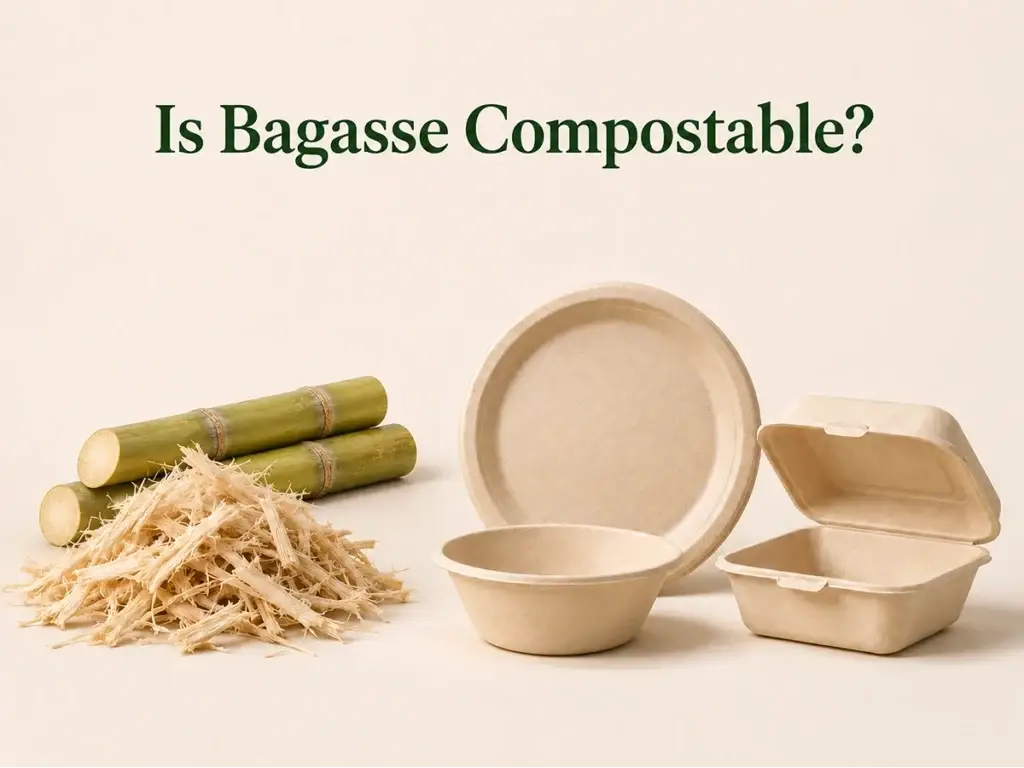
Is bagasse compostable? Sugarcane bagasse is a plant-based fiber that can break down under suitable composting conditions. However, this does not mean every product made from bagasse is automatically compostable. The finished product’s composition, surface treatments, and manufacturing process all influence its end-of-life performance.
Bagasse is commonly used to manufacture disposable plates, bowls, trays, and takeaway containers. For foodservice businesses and wholesale buyers, its compostability is an important consideration when evaluating sustainable packaging options.
This guide examines how bagasse composts, the differences between home and industrial composting, relevant certification standards, and the documentation buyers should request before sourcing bagasse tableware.
Key Takeaways
- Raw material: Sugarcane bagasse is a plant-based fiber left after sugarcane juice extraction.
- Composting conditions: Industrial and home composting involve different environmental conditions and requirements.
- Product composition: Coatings, additives, and other components can affect the compostability of finished tableware.
- Certification: A compostable raw material does not automatically make every finished product certified compostable.
- Wholesale sourcing: Buyers should verify product-specific test reports, certification scope, and material declarations before ordering.
What Makes Bagasse Compostable?
Bagasse is the fibrous residue remaining after sugarcane is processed to extract juice. Its fibers can be recovered, processed into pulp, and molded into products such as foodservice plates, bowls, and takeaway containers.
The material contains naturally occurring plant fibers, including cellulose and hemicellulose. These organic components can be broken down by microorganisms under suitable biological conditions.
How Is Sugarcane Bagasse Processed?
The production of molded bagasse tableware generally involves four stages:
- Fiber preparation: Sugarcane residue is collected and prepared for processing.
- Pulping: The fibers are separated and converted into a suitable pulp.
- Molding: The pulp is formed into plates, bowls, trays, and other product shapes.
- Drying and finishing: Molded products are dried and prepared for their intended applications.
The manufacturing process determines more than the product’s shape. Fiber quality, pulp consistency, molding conditions, and finishing treatments all influence the finished product.
For buyers, the distinction between raw bagasse fiber and finished tableware is particularly important. A material’s natural ability to biodegrade does not establish that a manufactured plate or container meets compostability requirements.
The complete product, including any coatings or additional components, must be evaluated.
Is Bagasse Home Compostable or Industrially Compostable?
Bagasse products may be designed for industrial composting or, where supported by appropriate testing, home composting. These disposal environments differ considerably in temperature, moisture control, aeration, and processing conditions.
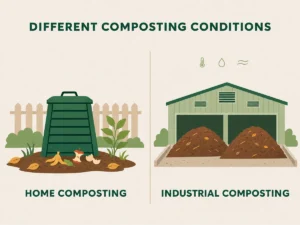
Industrial Composting
Industrial composting facilities manage organic waste under controlled conditions to support microbial decomposition.
Typical operating conditions include:
- Managed temperature and moisture levels
- Adequate oxygen circulation
- Controlled processing and aeration
- Regular monitoring of composting conditions
These conditions can support the decomposition of suitable molded-fiber products more consistently than many household systems.
However, industrial compostability certification does not guarantee that every commercial composting facility will accept a particular product. Local collection rules and facility capabilities should also be checked.
Home Composting
Home composting takes place in smaller systems, such as garden compost bins and household composters. Conditions are generally less controlled, with temperature, moisture, and microbial activity varying according to climate and maintenance.
This can make decomposition slower and less predictable.
A product certified for industrial composting should not automatically be described as home compostable. Buyers should look for documentation specifically covering home composting before using that claim.
| Comparison | Industrial Composting | Home Composting |
|---|---|---|
| Environment | Managed commercial facilities | Household composting systems |
| Temperature | More controlled | Variable |
| Moisture | Managed conditions | Depends on climate and maintenance |
| Processing | More consistent | Less predictable |
| Verification | Industrial compostability testing or certification | Home compostability testing or certification |
For importers and distributors, this distinction affects product positioning. If a product is certified only for industrial composting, its packaging and marketing should communicate that limitation clearly.
How Long Does Bagasse Take to Compost?
There is no universal decomposition period for bagasse tableware. The time required depends on the product’s construction and the conditions in which it is composted.
A thin molded-fiber plate and a thicker food container may behave differently, even when both are made primarily from sugarcane fibers.
Factors That Affect Composting Time
Temperature: Temperature influences microbial activity. Industrial facilities can maintain more consistent composting conditions, while household systems experience greater fluctuations.
Moisture: Microorganisms need sufficient moisture to break down organic materials. Dry conditions can slow decomposition, while excessive moisture and poor aeration may interfere with the composting process.
Oxygen Availability: Aerobic composting depends on adequate oxygen. Proper aeration supports the biological activity needed to break down organic fibers.
Product Thickness and Density: Material thickness, fiber density, and product geometry affect how readily microorganisms can access the material.
Coatings and Additional Components: Barrier coatings, additives, and other surface treatments may change the decomposition behavior of the complete product.
For this reason, suppliers should not apply a single decomposition time to every bagasse product without supporting test data.
When comparing compostability claims, buyers should ask for the test standard, testing conditions, and exact product covered by the report. A general statement such as “decomposes in 60 days” provides little purchasing assurance unless its basis is clearly documented.
Are Coated Bagasse Products Compostable?
The composition of a finished product matters as much as its primary fiber material. Some bagasse tableware incorporates surface treatments to improve resistance to moisture or grease. These additions may affect how the complete product performs during composting.
Uncoated Bagasse Products
Uncoated molded-fiber products generally have a simpler material composition, making their compostability easier to assess.
However, the absence of a coating is not proof of certification. Product construction, processing additives, and applicable testing requirements still need to be considered.
Coatings, Additives, and Surface Treatments
Depending on the intended application, manufacturers may use additional materials to improve the performance of bagasse food packaging.
These may include:
- Moisture-resistant coatings
- Grease-resistant treatments
- Laminated or barrier layers
- Printing inks and finishing materials
- Additional binders or processing additives
Not all coatings have the same composition or environmental characteristics. Buyers should therefore avoid assuming that every coated product is non-compostable—or that every uncoated product is certified compostable.
PFAS-related documentation may also be relevant when evaluating grease-resistant food packaging. Buyers should request appropriate material declarations or test reports rather than relying on general claims such as PFAS-free.
For procurement teams, the key question is whether the complete finished article, including its coatings and other components, has been evaluated under the relevant compostability requirements.
What Certifications Prove Bagasse Is Compostable?
Compostability certifications and testing standards provide a basis for evaluating environmental claims. For international buyers, the challenge is understanding which standard applies to the product and its intended disposal environment.
BPI and ASTM Standards
In North America, BPI certification is a recognized third-party certification program for products meeting applicable commercial compostability requirements.
Two relevant ASTM standards are:
- ASTM D6400: Covers plastics designed for aerobic composting in municipal or industrial facilities.
- ASTM D6868: Covers products made from plastics or polymers used as coatings or additives on paper and other substrates intended for aerobic composting.
ASTM D6868 is particularly relevant to certain coated fiber-based packaging applications.
The applicable standard depends on the finished product’s construction. Buyers should not assume that every molded bagasse plate or container falls under the same testing category.
EN 13432 and OK compost
For European markets, EN 13432 establishes requirements for packaging recoverable through composting and biodegradation.
The standard addresses several aspects of product performance:
- Biodegradability under specified test conditions
- Disintegration during composting
- Effects on the resulting compost
- Limits on regulated substances
OK compost certifications provide additional verification for specific composting environments.
The two commonly referenced categories are:
- OK compost INDUSTRIAL: For products intended for industrial composting.
- OK compost HOME: For products intended for home composting.
These categories are not interchangeable. Industrial compostability should not be presented as evidence of home compostability.
What Should Buyers Check on a Certificate?
When reviewing a supplier’s certification, verify the following information:
| Verification Item | What to Check |
|---|---|
| Certificate holder | Manufacturer or responsible certificate holder |
| Standard | Applicable ASTM, EN, or certification program |
| Product coverage | Exact product name, model, or product family |
| Material composition | Whether coatings and additional components are included |
| Validity | Certificate status and applicable conditions |
A certificate covering a raw material or individual component does not automatically establish that every finished product made from it is certified compostable.
For importers, confirming product coverage is particularly important when a supplier offers multiple plate sizes, container designs, or material configurations.
What Should Buyers Verify Before Sourcing Bagasse Tableware?
For wholesale buyers, selecting bagasse tableware involves more than confirming that the main material is plant-based. Product specifications, compliance documentation, and manufacturing consistency all affect whether an item is suitable for its intended market.
Material Composition and Product Specifications
Start by requesting a detailed product specification sheet.
| Specification | Information to Confirm |
|---|---|
| Material composition | Main fibers, coatings, binders, and additives |
| Product dimensions | Diameter, length, width, and height |
| Thickness and weight | Actual measurements and tolerances |
| Product structure | Shape, capacity, and compartment configuration |
| Surface treatment | Coatings and finishing materials |
| Packaging | Units per pack and export carton dimensions |
Do not rely on product descriptions alone. Two plates with similar dimensions may differ in thickness, material consumption, and construction.
Samples should also be evaluated under realistic foodservice conditions. For example, a plate intended for hot takeaway meals should be tested with representative foods and over the expected serving period.
Certification and Compliance Documents
Documentation requirements depend on the destination market, product composition, and intended application.
Buyers should request relevant supporting documents, including:
- Complete material declarations
- Applicable food-contact test reports
- Compostability test reports
- Valid third-party certification documents
- Information about coatings and chemical restrictions
Food-contact compliance and compostability are separate requirements. A product meeting food-contact requirements is not automatically compostable, and compostability certification does not replace food-contact documentation.
Supplier and Product Verification
When evaluating a bagasse tableware supplier, look beyond general environmental claims. A reliable sourcing assessment should establish whether the supplier can provide:
- Product-specific specifications and material information
- Supporting test reports and certifications
- Consistent production quality
- Custom dimensions and product configurations
- Private-label packaging options
- Clear MOQ and production lead-time information
For private-label and wholesale programs, approved samples and documented specifications help prevent discrepancies between initial product evaluation and mass production.
Buyers sourcing several product categories should also verify each product separately. Certification for one plate design should not automatically be assumed to cover every bowl, tray, or takeaway container in the supplier’s range.
Conclusion
Bagasse is a plant-based fiber that can be composted under suitable conditions. However, the compostability of finished bagasse tableware depends on its material composition, coatings, and processing conditions.
For buyers, verifying product-specific certifications and test reports is essential. Raw material claims alone are not enough to establish whether a finished product is compostable.
FAQs
Is bagasse biodegradable or compostable?
Bagasse is a plant-based fiber that can biodegrade under suitable biological conditions and may be composted. However, the compostability of finished products depends on their composition, processing, and applicable testing or certification.
Can you compost bagasse plates at home?
Some bagasse plates may be suitable for home composting, but not all are certified for it. Check the finished product’s certification and follow the disposal instructions provided by the manufacturer.
Are all bagasse plates compostable?
No. Although bagasse fibers can be composted, coatings, additives, and product construction may affect the finished article. Buyers should verify product-specific compostability documentation.
Are coated sugarcane plates compostable?
Some coated sugarcane plates may meet compostability requirements, depending on their coating and complete material composition. Appropriate testing and certification are needed to support the claim.
How long does sugarcane bagasse take to decompose?
There is no universal decomposition period. Temperature, moisture, oxygen availability, product thickness, and composting conditions all influence how quickly bagasse products break down.
Can bagasse food containers be composted?
Some bagasse food containers are designed for composting, but their suitability depends on coatings, additives, and product-specific certification. Buyers should check whether the complete container is covered by the relevant documentation.
Let's discuss your product requirements.
Share your product brief, estimated quantity and target timeline with WVSCM.
Request a Quote