



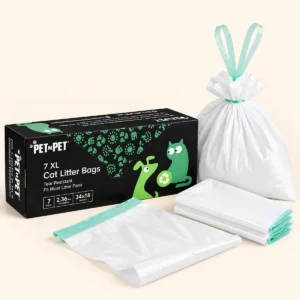
Cat litter liner specifications determine how well a product fits different litter boxes and meets specific purchasing requirements. For wholesalers, importers, and pet supply brands, selecting cat litter liners involves more than choosing an XL or Jumbo size. Buyers should also evaluate actual dimensions, material composition, film thickness, closure design, and packaging.
A complete cat litter liner specification defines the product’s physical dimensions, material requirements, and quality criteria. These details support product selection, supplier quotations, sample approval, bulk production, and consistent repeat orders.
This guide is designed for pet supply brands, importers, wholesalers, and distributors. It explains the key product specifications, material options, thickness considerations, and quality evaluation methods for cat litter liners. It also covers how to prepare a purchasing specification and evaluate OEM and private-label suppliers.
Key Takeaways
- Product Size: Determine liner dimensions based on the litter box’s length, width, sidewall height, and opening configuration.
- Material Composition: LDPE and LLDPE are common polyethylene film materials. Confirm the actual formulation before purchasing.
- Film Thickness: Compare thickness in microns (μm) or mil, alongside material composition and relevant test results.
- Closure Design: Standard open-top liners and drawstring liners have different construction and handling requirements.
- Quality Control: Evaluate dimensions, thickness tolerance, film consistency, seals, and drawstring construction.
- Wholesale Purchasing: Confirm MOQ, pack quantity, carton configuration, packaging, and production lead time.
- Custom Manufacturing: Define dimensions, material, thickness, branding, and packaging requirements before sample approval.
What Size Cat Litter Liner Fits Your Litter Box?
The correct cat litter liner size depends on the litter box’s internal length, width, sidewall height, and opening configuration.
Selecting a liner requires more than matching the bottom dimensions. The liner must also provide enough material to cover the sides and allow proper installation.
How Do You Measure a Litter Box?
Before selecting a liner, measure the actual dimensions of the litter box.
-
Length: Measure the longest internal distance of the litter box.
-
Width: Measure the widest internal distance.
-
Sidewall Height: Measure from the bottom to the upper edge.
-
Opening Dimensions: Check the opening size and available material for folding over the rim.
-
Shape: Consider sloped walls, raised edges, and irregular corners.
These measurements provide a starting point for selecting a compatible liner. Final fit also depends on bag construction and installation design.
A liner that matches the base dimensions may still lack sufficient sidewall coverage. This can make installation difficult or cause the liner to pull away from the edges.
What Is the Difference Between XL and Jumbo Cat Litter Liners?
XL and Jumbo are common product size categories, but they are not universal industry standards. Different manufacturers may use different dimensions for these labels.
WVSCM’s current product specifications list the following dimensions:
| Product Size | Dimensions | Approximate Inches |
|---|---|---|
| XL | 860 × 450 mm | 33.9 × 17.7 in |
| Jumbo | 920 × 460 mm | 36.2 × 18.1 in |
Note: These dimensions come from WVSCM product information. Confirm the latest approved product specifications before quotation or production.
For custom purchasing, define the required length, width, opening dimensions, and sidewall coverage. This gives manufacturers a clearer basis for product development and sampling.
Looking for different liner sizes for your product program? Explore our Cat Litter Liners for available size options and customization details.
Which Materials Are Used in Cat Litter Liners?
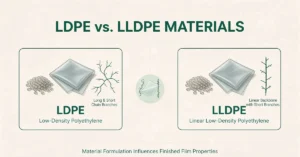
LDPE and LLDPE are common polyethylene materials used in cat litter liner manufacturing. They have different material characteristics, so buyers should review the actual formulation rather than relying on material names alone.
LDPE vs. LLDPE
LDPE (Low-Density Polyethylene)
LDPE is a polyethylene material commonly used in flexible film production. Its finished-product properties depend on resin grade, formulation, film thickness, and processing conditions.
LLDPE (Linear Low-Density Polyethylene)
LLDPE is another polyethylene material widely used in flexible film manufacturing. Its finished properties also depend on the selected resin grade and formulation. Buyers should evaluate it according to the intended product requirements rather than the material name alone.
Neither material is universally better for every cat litter liner application.
| Comparison | LDPE | LLDPE |
|---|---|---|
| Full Name | Low-Density Polyethylene | Linear Low-Density Polyethylene |
| Material Structure | More branched molecular structure | Linear backbone with short branches |
| Common Application | Flexible plastic films | Flexible plastic films |
| Performance Consideration | Depends on resin grade and formulation | Depends on resin grade and formulation |
The comparison describes general material characteristics. Actual film performance depends on formulation, processing, and finished-product specifications.
Material Selection for OEM Projects
WVSCM’s current cat litter liner product information identifies an LDPE and LLDPE material combination. The actual formulation and whether the film uses a blended or multilayer structure should be confirmed with the product team.
For OEM and private-label projects, buyers should request a material declaration or formal product specification that identifies:
-
Resin types and percentage by weight.
-
Recycled or bio-based content, if applicable.
-
Additional additives, if applicable.
-
Whether the film is blended or multilayered.
Clear material information supports sample evaluation and consistency across production orders.
How Thick Should a Cat Litter Liner Be?
Cat litter liner thickness refers to the measured thickness of the finished plastic film. It is commonly expressed in microns (μm) or mil.
One mil equals 25.4 μm. Using consistent units allows buyers to compare thickness specifications from different suppliers.
Thickness indicates film dimensions and material usage. However, it does not independently establish tear resistance or finished-product durability.
Understanding Microns and Mil
| Measurement | Conversion | Purchasing Relevance |
|---|---|---|
| 1 mil | 25.4 μm | Converts imperial thickness to metric |
| 1 μm | 0.001 mm | Expresses thin film measurements |
| 0.001 inch | 1 mil | Imperial thickness reference |
A thicker film generally uses more material per unit area. However, finished-product performance also depends on material formulation, film uniformity, sealing, and manufacturing conditions.
Thickness Options in WVSCM Product Records
WVSCM’s reviewed product and sample records include the following thickness configurations:
| Product Configuration | Recorded Thickness | Approx. mil |
|---|---|---|
| Drawstring Liner Sample | 12 μm | 0.47 mil |
| Drawstring Liner Sample | 20 μm | 0.79 mil |
| Drawstring Liner Sample | 30 μm | 1.18 mil |
| Cat Litter Liner Project | 50 μm | 1.97 mil |
| Lavender-Scented Liner Sample | 63.5 μm | 2.50 mil |
Note: These figures represent different products and sample configurations. They are not a recommended industry range or a performance guarantee.
For purchasing decisions, evaluate thickness alongside material composition, film uniformity, sealing structure, and actual test results.
Which Tests Help Evaluate Plastic Film Quality?
Different testing methods evaluate different film properties.
| Test Standard | Evaluation Area | Purchasing Relevance |
|---|---|---|
| ASTM D6988 | Plastic film thickness measurement | Provides a method for measuring film thickness |
| ASTM D882 | Tensile properties | Evaluates specimen behavior under tensile loading |
| ASTM D1709 | Dart impact resistance | Evaluates specimen resistance under specified impact conditions |
These ASTM standards are test methods. They are not certifications that every cat litter liner must obtain, nor do they establish universal performance requirements for all products.
Buyers should agree with the supplier and testing laboratory on applicable test methods, testing conditions, required results, and acceptance criteria.
Are Drawstring Cat Litter Liners Better Than Standard Liners?
Drawstring cat litter liners have an integrated closure that can be gathered during removal. Standard liners generally have an open top without this feature.
Each design has different construction characteristics. The appropriate option depends on product dimensions, intended use, and handling requirements.
| Comparison | Drawstring Liners | Standard Liners |
|---|---|---|
| Opening | Integrated drawstring | Open top |
| Closure | Gathered drawstring | No integrated closure |
| Construction | Additional cord component | Simpler construction |
| Quality Checks | Cord attachment and closure function | Film and seal quality |
| Purchasing Focus | Closure convenience | Basic liner configuration |
Drawstring designs introduce additional manufacturing requirements. Buyers should evaluate cord material, attachment, opening dimensions, and closure function.
Standard designs use a simpler open-top construction and may suit product programs that prioritize basic liner configurations.
For bulk purchasing, confirm the closure design before requesting quotations and approving samples.
How Can Buyers Evaluate Cat Litter Liner Quality?
Cat litter liner quality should be evaluated against documented dimensions, material composition, thickness, construction, and agreed performance requirements.
A physical sample provides a reference for comparing the finished product with the purchase specification.
What Should Cat Litter Liner Quality Inspection Include?
| Inspection Item | What to Check | Purchasing Purpose |
|---|---|---|
| Dimensions | Length, width, and opening | Confirm product compatibility |
| Film Thickness | Actual thickness and tolerance | Verify specification consistency |
| Material | Resin composition and declarations | Confirm material requirements |
| Film Surface | Visible defects and uniformity | Identify production issues |
| Seals | Seal integrity and consistency | Evaluate sealing quality |
| Drawstring | Attachment and closure function | Verify closure requirements |
| Packaging | Quantity, labels, and carton details | Support storage and distribution |
These are recommended inspection areas. They do not represent uniform inspection limits already established for every WVSCM product.
The supplied project records do not include finished-product test results, thickness tolerances, seal-strength limits, or formal inspection acceptance criteria. Buyers should request these records when they are required for a project.
How Should Buyers Approve Cat Litter Liner Samples?
A documented sample approval process helps buyers and manufacturers establish consistent product requirements.
- Confirm Requirements: Define dimensions, material, target thickness, closure, packaging, and intended application.
- Review Samples: Check whether the sample matches the purchasing specification.
- Record Inspection Results: Document dimensions, thickness, material information, and relevant test results.
- Approve a Reference Sample: Retain the final approved sample and specification revision.
- Confirm Mass Production: Use the approved specification as the reference for production and inspection.
This process provides a shared product reference and helps reduce differences between approved samples and bulk orders.
How Do You Choose a Wholesale Cat Litter Liner Supplier?
For wholesale and OEM purchasing, buyers should evaluate suppliers against a clear written specification rather than comparing unit prices alone.
Important considerations include product capabilities, sample consistency, quality controls, customization options, MOQ, production lead time, packaging, and delivery terms.
Customization Options for Cat Litter Liners
Custom cat litter liner programs can define product specifications according to project requirements.
| Customization Area | Requirements to Discuss |
|---|---|
| Dimensions | Custom length and width |
| Material | Approved LDPE or LLDPE formulations |
| Thickness | Target thickness and tolerance |
| Closure | Standard opening or drawstring |
| Packaging | Retail boxes or bulk packaging |
| Branding | Logo, packaging design, and private-label labels |
Available options depend on the manufacturer’s capabilities and the approved product specification. Buyers should confirm whether each requested customization affects MOQ, pricing, or production lead time.
What Should Buyers Include in a Purchase Specification?
A complete cat litter liner purchase specification should define dimensions, materials, thickness, closure, packaging, quality requirements, and order details.
Buyers can use the following checklist when preparing an RFQ (Request for Quotation).
| Specification Item | Information to Provide |
|---|---|
| Product Type | Standard, XL, Jumbo, or drawstring |
| Product Dimensions | Length, width, and opening size |
| Material | LDPE, LLDPE, or approved formulation |
| Film Thickness | Target thickness and permitted tolerance |
| Closure Design | Standard opening or drawstring |
| Packaging | Retail box, bulk packaging, or custom packaging |
| Pack Quantity | Units per pack or roll |
| Carton Configuration | Units per carton and carton dimensions |
| Branding | Logo and private-label requirements |
| Quality Standards | Inspection items and acceptance criteria |
| Order Quantity | Estimated quantity by SKU |
| Delivery Requirements | Target delivery schedule and shipping terms |
A complete specification sheet provides a common reference for supplier quotations, sample approval, production inspection, and repeat orders.
Buyers should separate mandatory requirements from optional customization items to improve quotation accuracy and procurement efficiency.
Working with an OEM Cat Litter Liner Supplier
For private-label projects, buyers should confirm product specifications, quotation details, sample requirements, packaging artwork, and production approval before mass manufacturing.
Keeping written approval records at each stage helps reduce communication gaps and maintain consistency across production orders and repeat purchases.
WVSCM supports product development and supply chain coordination for pet supply programs. Contact our team to discuss your cat litter liner dimensions, material requirements, packaging preferences, and wholesale purchasing needs.
FAQs
What Size Cat Litter Liner Should I Choose?
Measure the litter box’s internal length, width, and sidewall height. Select a liner that covers the base and sides. XL and Jumbo are not universal size standards, so compare actual product dimensions.
What Materials Are Commonly Used in Cat Litter Liners?
LDPE and LLDPE are common polyethylene film materials. Finished-product properties depend on resin formulation, thickness, and manufacturing conditions. Ask suppliers for a documented material specification.
Are Thicker Cat Litter Liners More Durable?
Not necessarily. Thickness alone does not prove durability. Material formulation, film uniformity, sealing, construction, and relevant test results also matter.
What Is the Difference Between Drawstring and Standard Cat Litter Liners?
Drawstring liners gather for closure, while standard liners remain open at the top. Buyers should compare closure function, dimensions, and construction requirements.
Can Cat Litter Liners Be Customized for Wholesale Orders?
Customization may cover dimensions, material, thickness, closure, packaging, and branding. Confirm available options in a written specification and quotation.
Let's discuss your product requirements.
Share your product brief, estimated quantity and target timeline with WVSCM.
Request a Quote