

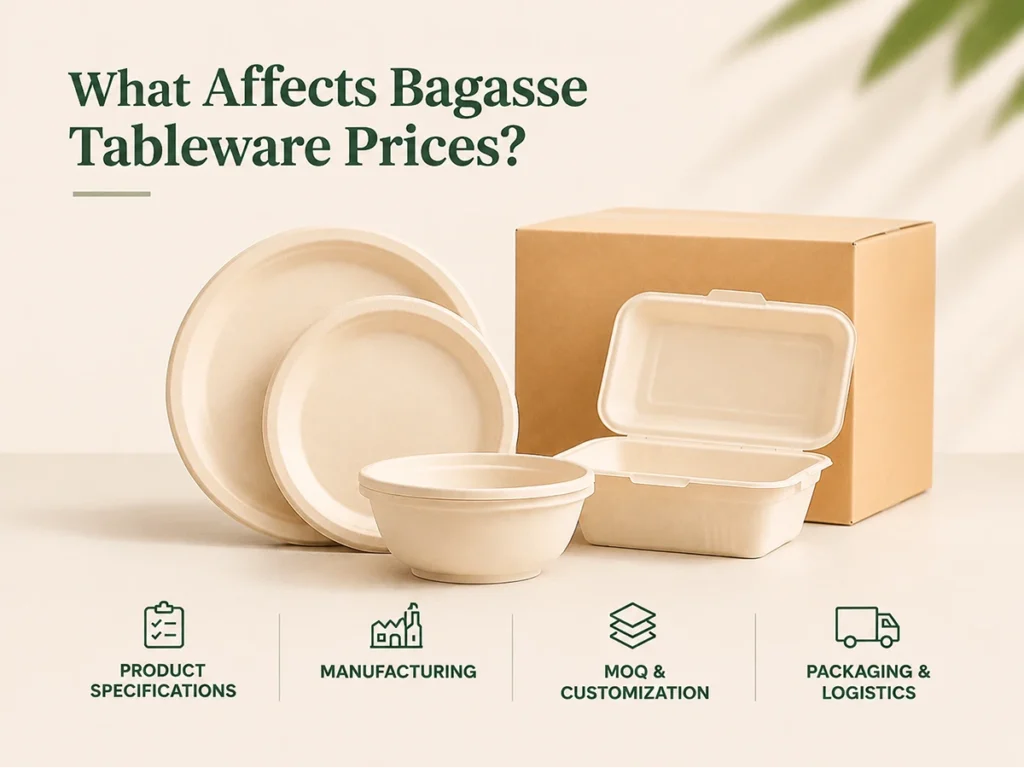
Bagasse tableware price depends on product specifications, material usage, manufacturing requirements, order quantity, customization, and shipping arrangements. Even products made from the same sugarcane fiber can have different wholesale prices because their dimensions, weight, structure, and production requirements vary.
For importers, wholesalers, distributors, and private-label brands, understanding these differences is essential when evaluating supplier quotations. A lower unit price does not necessarily mean a lower purchasing cost. Product weight, carton capacity, packaging, and delivery terms can all affect the total cost of an order.
This guide explains seven factors that influence bagasse tableware prices. It also shows how to compare wholesale quotations, evaluate product specifications, and calculate the landed cost of imported products.
Key Takeaways
- Product specifications: Dimensions, weight, thickness, and structural design influence material consumption and production requirements.
- Materials and manufacturing: Fiber composition, mold design, forming, drying, and finishing affect production costs.
- Product performance: Strength, grease resistance, water resistance, and heat requirements may affect material selection and processing.
- Order quantity: MOQ and production volume influence manufacturing efficiency and unit pricing.
- Customization: Custom molds, printing, and private-label packaging can add project-specific expenses.
- Packaging and logistics: Carton dimensions, packing quantities, and freight arrangements affect total purchasing costs.
- Supplier quotations: Buyers should compare equivalent specifications, quantities, packaging, and delivery terms before selecting a supplier.
What Determines Bagasse Tableware Prices?
Bagasse tableware prices are primarily determined by product specifications, material consumption, manufacturing requirements, performance expectations, order quantity, customization, and logistics. These factors influence both the quoted unit price and the total purchasing cost.
For B2B buyers, the most important distinction is between the factory price and the total cost of receiving the finished products.
| Pricing Factor | Main Variables | Impact on Buyers |
|---|---|---|
| Product specifications | Size, weight, thickness, shape | Determines material usage and product requirements |
| Material requirements | Fiber composition and formulation | Influences material consumption |
| Manufacturing | Molding, drying, and finishing | Affects production efficiency |
| Product performance | Strength and resistance requirements | May require additional processing |
| Order quantity | MOQ and production volume | Influences unit pricing |
| Customization | Molds, printing, and packaging | Adds development and setup costs |
| Logistics | Carton size and freight | Changes total purchasing cost |
Not every factor contributes to the quotation in the same way. Product specifications and manufacturing establish production requirements, while customization and packaging introduce project-specific expenses. Shipping and import charges determine additional costs associated with receiving the goods.
For wholesale buyers, a reliable price comparison starts with equivalent product specifications and commercial terms.
How Do Product Size and Weight Affect Bagasse Tableware Price?
Product size and weight are important factors affecting bagasse tableware price. Larger products generally require more material, while heavier products use more fiber per finished piece. Both can influence manufacturing requirements and supplier quotations.
How Do Product Dimensions Affect Cost?
Bagasse tableware includes plates, bowls, compartment trays, and hinged takeaway containers. Each product format requires a different mold design and material distribution.
| Product Type | Main Specification Factors | Pricing Considerations |
|---|---|---|
| Bagasse Plates | Diameter, rim design, and weight | Material usage and structural strength |
| Bagasse Bowls | Capacity, depth, and wall thickness | Material distribution and forming |
| Compartment Trays | Dimensions and compartment layout | Mold complexity and structure |
| Clamshell Containers | Size, hinge, and lid design | Mold configuration and functional requirements |
| Food Trays | Length, width, depth, and shape | Product weight and structural design |
A large plate may require more fiber than a smaller plate. A compartment tray may also need a more complex mold than a flat serving plate.
These differences affect material consumption, production arrangements, and the final product specification.
Does Product Weight Affect Wholesale Price?
Unit weight is an important reference when comparing bagasse tableware quotations. It indicates the amount of material used in each finished piece.
Two plates with the same diameter may have different weights because of differences in thickness, rim design, or structural requirements.
Buyers should request:
- Product dimensions and weight per piece.
- Thickness or relevant structural specifications.
- Product shape and compartment configuration.
- Intended foodservice application.
- Applicable performance requirements.
A heavier product is not automatically better. Its suitability depends on the food being served and the expected conditions of use.
Business implication: Compare products with equivalent dimensions, weight, and functional requirements. Otherwise, a lower quotation may simply reflect a lighter or differently designed product.
How Do Materials and Manufacturing Affect Bagasse Tableware Cost?
Material requirements and manufacturing processes influence bagasse tableware cost. Although these products are made primarily from sugarcane fiber, differences in pulp preparation, formulation, mold design, and production controls can affect the finished product.
How Does Sugarcane Fiber Preparation Affect Cost?
Bagasse is the fibrous residue left after sugarcane juice extraction. It is processed into pulp before being formed into tableware.
The preparation process may involve cleaning, fiber treatment, pulping, and slurry conditioning. Consistent pulp quality helps maintain predictable forming conditions and finished-product specifications.
Material composition may also differ between product programs. Buyers should confirm the fiber source, material declaration, and any additional functional treatments used in the finished product.
For more background, read our guide to what bagasse tableware is.

How Does Mold Design Affect Manufacturing Cost?
Mold design determines the shape and structural details of the finished product. Product-specific molds are used to manufacture plates, bowls, trays, and containers.
Different product geometries create different production requirements:
- Flat plates have relatively straightforward forming geometries.
- Deep bowls require suitable depth and wall formation.
- Compartment trays need molds that define separate sections.
- Hinged containers require coordinated base, lid, and hinge structures.
Custom designs may also require additional tooling development and sample approval.
Do Drying and Finishing Affect Production Costs?
After forming, molded fiber products undergo further processing to achieve their finished shape and condition.
Depending on the manufacturing method, these stages may include drying, hot pressing, trimming, and inspection.
Production consistency matters because variations in weight, dimensions, and surface finish can affect product acceptance and repeat orders.
For a more detailed explanation, read our guide to how bagasse tableware is made.
Business implication: Confirm whether the quoted product uses an existing mold or requires new tooling. Mold requirements, production complexity, and inspection standards should be clear before approving an order.
Do Product Performance and Coatings Increase Bagasse Tableware Prices?
Product performance requirements can influence bagasse tableware prices because different foodservice applications place different demands on the finished product. A plate used for dry food may not require the same characteristics as a container used for hot, moist, or oily meals.
| Performance Requirement | What Buyers Should Evaluate | Potential Cost Consideration |
|---|---|---|
| Structural strength | Resistance to bending and deformation | Product weight and design |
| Water resistance | Performance with moist foods | Material formulation or treatment |
| Grease resistance | Suitability for oily foods | Surface treatment or material requirements |
| Heat resistance | Intended food temperature and use conditions | Product design and testing |
| Food-contact suitability | Material composition and applicable requirements | Testing and documentation |
Are Coatings Always Necessary?
Not every bagasse product requires the same surface treatment. Some products may meet their intended requirements through material composition and molded structure. Others may require additional treatments based on their application.
The presence of a coating does not automatically indicate better quality. Buyers should understand its purpose, composition, and suitability for the intended food-contact conditions.
For products intended for the US market, applicable food-contact requirements should also be considered. The FDA provides guidance on Food Contact Substances.
Testing and documentation should relate to the actual finished product, its composition, and intended conditions of use.
For additional background, read our guide to bagasse tableware safety, subject to confirming the published URL.
Business implication: Specify food types, temperature conditions, and expected holding times before sourcing. This helps suppliers recommend suitable specifications without introducing unnecessary treatments.
How Does MOQ Affect Bagasse Tableware Wholesale Price?
Minimum order quantity (MOQ) and production volume influence both the quoted unit price and the initial investment required for a bagasse tableware project. Their impact depends on the product, manufacturing setup, available molds, and packaging requirements.
What Is MOQ in Bagasse Tableware Manufacturing?
MOQ, or Minimum Order Quantity, is the smallest quantity a supplier accepts for a particular order or product arrangement. It may be defined per SKU, design, or production run.
Larger orders may allow manufacturers to distribute certain setup and production expenses across more units. This can improve production efficiency and reduce the unit cost.
However, a higher MOQ does not guarantee a lower price in every situation. Material requirements, production complexity, packaging, and order specifications still matter.
What Should Buyers Confirm About MOQ?
Before requesting a quotation, confirm:
- MOQ for each product or SKU.
- Whether mixed-SKU orders are accepted.
- Whether different designs require separate production runs.
- Whether existing molds are available.
- Whether repeat orders use the same approved specifications.
For wholesalers managing multiple product categories, mixed-SKU arrangements may also affect production planning and packing requirements.
Business implication: Request quotations at different order quantities when possible. Comparing the same product at different volumes helps identify whether production scale changes the unit price.
Does Customization Increase Bagasse Tableware Cost?
Customization can add expenses to a bagasse tableware project. The actual impact depends on how much the requested product differs from the manufacturer’s existing range.
| Customization Type | Potential Cost Impact |
|---|---|
| Existing mold selection | May avoid new tooling development |
| Custom mold | Tooling and development expenses |
| Custom dimensions | Design and production adjustments |
| Logo printing | Artwork and printing requirements |
| Private-label packaging | Packaging materials and setup |
| Custom carton | Carton specifications and printing |
Custom mold development is particularly relevant to projects involving unique shapes or compartment configurations.
Private-label brands may also request customized packaging, printing, or product specifications. These requirements should be identified before production planning begins.
Before approving a custom order, buyers should clarify tooling ownership where relevant, sample approval procedures, production specifications, and additional testing requirements.
Business implication: If your project does not require a unique design, ask whether an existing mold can meet your specifications. This may reduce initial development expenses and simplify production.
How Do Packaging and Shipping Affect Total Cost?
Packaging and shipping affect the total cost of purchasing bagasse tableware, particularly for international orders. Product unit price alone does not show how much it will cost to transport and receive the goods.
For importers, carton dimensions, packing quantities, shipment volume, and delivery terms should all be included in the quotation review.
How Do Carton Size and Packing Quantities Affect Shipping Cost?
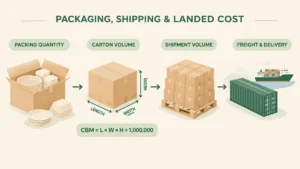
The number of pieces packed in each carton affects total shipment quantity and packaging efficiency. Carton dimensions determine shipment volume, commonly measured in cubic meters (CBM).
CBM represents the external carton volume in cubic meters.
CBM Formula:
CBM = Length (cm) × Width (cm) × Height (cm) ÷ 1,000,000
For example, a carton measuring 50 × 40 × 30 cm has a volume of 0.06 CBM.
This measurement helps buyers estimate shipment volume and compare packing efficiency. However, carton volume alone does not determine the final freight charge. Actual freight pricing may also depend on shipment weight, transport mode, route, and carrier requirements.
Buyers should request:
- Pieces per carton.
- Carton length, width, and height.
- Gross and net carton weight.
- Total carton quantity.
- Total shipment CBM.
- Estimated container loading quantity, where available.
How Do Trade Terms Affect Landed Cost?
FOB and CIF are Incoterms® rules. Landed cost represents the total applicable cost of bringing goods to the agreed destination.
| Cost Component | FOB Quotation | CIF Quotation |
|---|---|---|
| Product value | Included | Included |
| Export clearance | Seller’s responsibility under FOB | Seller’s responsibility under CIF |
| Main international freight | Normally buyer’s responsibility | Seller arranges and pays |
| Cargo insurance | Not required under FOB | Seller arranges required insurance |
| Import duties and taxes | Normally buyer’s responsibility | Normally buyer’s responsibility |
| Destination handling | Depends on arrangements | Depends on arrangements |
| Inland delivery | Depends on arrangement | Depends on arrangement |
Under FOB and CIF, risk transfers when the goods are on board the vessel at the shipment port. The seller’s payment responsibilities differ, but CIF does not mean the seller retains shipping risk until the destination port.
The exact allocation of responsibilities depends on the agreed Incoterm, named port, contract, and applicable customs requirements.
The International Chamber of Commerce’s Incoterms® 2020 rules provide the official framework for allocating delivery obligations, risks, and costs between buyers and sellers.
How Can Buyers Calculate Landed Cost per Unit?
Landed cost per unit can be estimated by dividing total applicable purchasing and delivery expenses by the number of saleable units received.
Landed Cost per Unit = Total Landed Cost ÷ Saleable Units
Total landed cost may include:
- Product purchase value.
- International freight.
- Cargo insurance, if applicable.
- Import duties and taxes.
- Customs brokerage.
- Port and destination handling.
- Inland transportation.
- Other attributable charges.
For US imports, duty rates depend on the applicable tariff classification, country of origin, and other relevant trade measures. Buyers can consult the US International Trade Commission’s Harmonized Tariff Schedule.
The calculation should use saleable units rather than the original ordered quantity if damaged or rejected products reduce the quantity available for sale.
Business implication: Request carton specifications and a clear quotation basis before estimating landed cost. This allows you to compare suppliers based on the cost of receiving usable products, not only the factory price.
How Can Buyers Compare Bagasse Tableware Supplier Quotes?
Comparing bagasse tableware supplier quotations requires consistent product specifications, order quantities, packaging details, and delivery terms. A quotation with a lower unit price may not offer better value if it covers a different product weight, packing arrangement, or shipping basis.
For importers and wholesalers, a standardized Request for Quotation (RFQ) makes supplier comparisons more accurate.
What Information Should Buyers Request?
Before requesting a quotation, prepare a product specification sheet with the following information.
| Specification | Information to Confirm |
|---|---|
| Product type | Plate, bowl, tray, or container |
| Dimensions | Diameter, length, width, and depth |
| Unit weight | Weight per finished piece |
| Product design | Shape, compartments, and structure |
| Performance | Strength and resistance requirements |
| Material | Fiber composition and applicable treatments |
| Packaging | Pieces per inner pack and carton |
| Carton dimensions | Length, width, height, and CBM |
| Order quantity | MOQ and total quantity per SKU |
| Customization | Mold, printing, and packaging requirements |
| Quotation | Unit price, currency, and quotation validity |
| Delivery terms | EXW, FOB, CIF, or other agreed Incoterms |
These details help suppliers understand the project and prepare quotations based on the same requirements.
How Can Buyers Identify Differences Between Supplier Quotes?
When reviewing multiple quotations, pay attention to differences that may not be visible in the headline price.
1. Compare equivalent product specifications.
Check whether quoted products have the same dimensions, weight, structure, and intended performance. Differences in these specifications can affect the price.
2. Review packaging quantities.
Compare the number of pieces per carton and the carton dimensions. Different packing arrangements can change shipment volume and freight costs.
3. Confirm what the quotation includes.
Check whether mold development, printing, packaging, testing, and export-related expenses are included or quoted separately.
4. Verify product documentation.
Request relevant material declarations, food-contact documentation, and product-specific test reports where applicable. Confirm that the documents correspond to the actual product being quoted.
5. Compare delivery terms.
Make sure quotations use the same Incoterm and named destination or port. Otherwise, prices may cover different transportation and delivery responsibilities.
A professional quotation should identify the product, specifications, order quantity, unit price, packaging details, and delivery terms. Customized projects should also clarify tooling charges, sample approval, production lead time, and additional requirements.
Business implication: If important information is missing, request clarification before ranking suppliers. A comparable quotation should reflect the same product, packing, quantity, and commercial scope.
Conclusion
Bagasse tableware prices depend on more than the raw material. Product specifications, manufacturing requirements, performance expectations, MOQ, customization, and logistics all contribute to the total purchasing cost.
For B2B buyers, the most reliable approach is to compare products against consistent specifications and evaluate the full cost of procurement. A clear RFQ and agreed product requirements also help reduce misunderstandings during production and repeat orders.
WVSCM supports sustainable tableware sourcing, product development, and OEM customization. Explore our sustainable tableware solutions or contact our team to discuss your product specifications and sourcing requirements.
Let's discuss your product requirements.
Share your product brief, estimated quantity and target timeline with WVSCM.
Request a Quote