



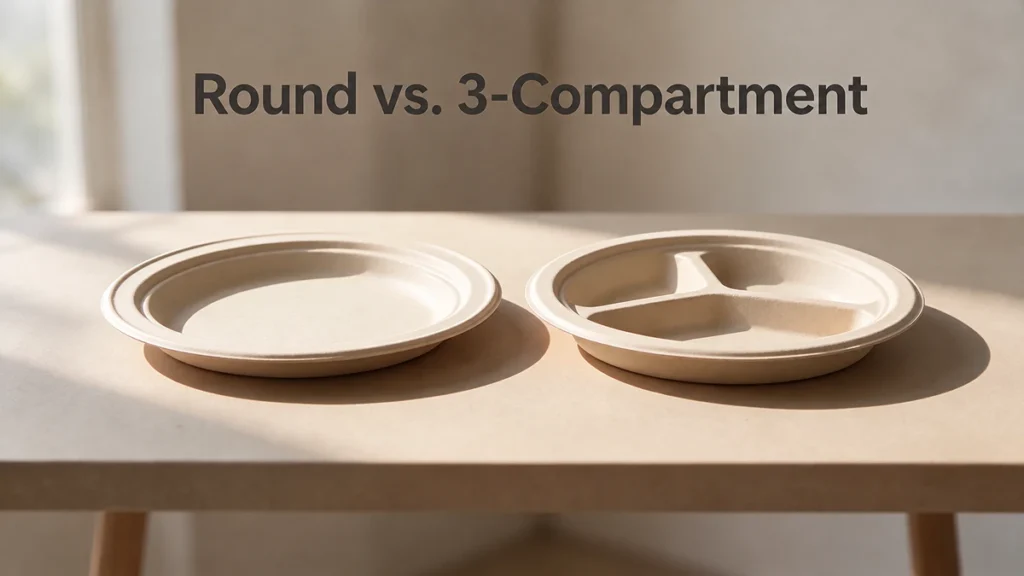
Round and 3-compartment bagasse plates serve different foodservice needs. Round plates provide an open serving surface for flexible food presentation, while 3-compartment bagasse plates separate main dishes, sides, and other food components. For foodservice buyers, the right format depends on menu combinations, portion sizes, and serving requirements.
Choosing between these designs involves more than comparing plate shapes. Buyers should consider usable serving area, compartment dimensions, food separation, and product performance during actual use.
What Is the Difference Between Round and 3-Compartment Bagasse Plates?
Round bagasse plates have one continuous serving surface. In comparison, 3-compartment bagasse plates use molded dividers to create three separate sections. Both designs are made from sugarcane fiber, but their structures support different meal formats.
Round Bagasse Plates: Flexible Food Presentation
Round bagasse plates provide an open surface without fixed food divisions. Buyers can use the same plate format for different combinations of main dishes, vegetables, sides, and desserts.
Common applications include:
- Buffet and self-service meals.
- Catering events with changing menus.
- Restaurants and general foodservice.
- Meals with mixed or irregular food portions.
Their main advantage is flexibility. A single plate design can accommodate different menu combinations without requiring buyers to follow a fixed food arrangement.

3-Compartment Bagasse Plates: Organized Meal Portions
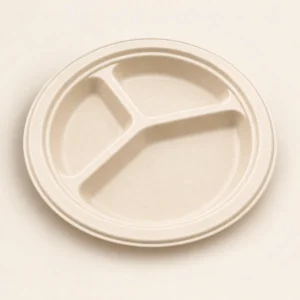
3-compartment bagasse plates divide the serving surface into three molded sections. This layout can accommodate a main dish and two accompanying food items, depending on the size and depth of each section.
They are commonly used for:
- School and university meal programs.
- Corporate cafeteria services.
- Prepared meals with defined portions.
- Institutional foodservice.
- Meal preparation and takeaway programs.
The three sections do not necessarily have equal capacity. Buyers should examine the actual layout to confirm that the largest section can hold the main dish and that the smaller sections suit the intended sides.
Round vs. 3-Compartment Bagasse Plates: How Do They Compare?
The key difference is how each design accommodates a meal. Round plates offer more freedom in food placement, while 3-compartment bagasse plates provide built-in separation.
| Comparison Factor | Round Bagasse Plates | 3-Compartment Bagasse Plates |
|---|---|---|
| Serving surface | One open area | Three divided sections |
| Food arrangement | Flexible | Organized by section |
| Portion separation | No built-in divisions | Built-in divisions |
| Menu changes | Easy to accommodate | Depends on section layout |
| Mixed food portions | Suitable | Suitable when portions fit each section |
| Sauces and sides | May mix with other foods | Can be placed in separate sections |
| Best-fit meal format | Flexible and mixed meals | Planned, portioned meals |
Neither design is automatically better for every foodservice operation. Round plates can be more practical for buffets with changing food combinations. 3-compartment bagasse plates are more suitable for standardized meals that require separate food portions.
The choice should follow the menu rather than the appearance of the plate.
Which Plate Structure Fits Different Meal Combinations?
Menu composition is one of the most useful ways to choose between round and 3-compartment bagasse plates. Buyers should consider the number of food components, their serving portions, and whether they need to remain separate.
Main Dish with Two Side Items
Recommended format: 3-compartment bagasse plates
A meal containing rice or another staple, a protein, and vegetables can fit a 3-compartment bagasse plate. The largest compartment should accommodate the main portion, while the other sections hold accompanying items.
Before selecting this format, check the usable area of each section. A plate with three compartments may still be unsuitable if the main section is too small.
Main Dish with Sauce or Gravy
Recommended format: Depends on the food combination
A separate compartment can help keep sauce or side items apart from the main dish. However, section depth and food consistency matter.
For meals with generous sauce portions, buyers should test whether the compartment holds the intended serving without overflow during handling. A compartment divider alone does not guarantee leakproof performance.
Mixed Meals with Several Ingredients
Recommended format: Round bagasse plates
Round plates offer an uninterrupted surface for meals with mixed ingredients, irregular portions, or changing combinations. They are practical when food does not need to be separated into fixed sections.
Standardized Prepared Meals
Recommended format: 3-compartment bagasse plates
Prepared meal programs often use consistent food combinations and portion arrangements. A 3-compartment bagasse plate can support repeatable presentation across multiple servings.
This format is particularly useful when operators serve standardized combinations of staple foods, protein, and vegetables.
Menu-to-Plate Selection Guide
| Meal Combination | Suggested Format | What to Check |
|---|---|---|
| Main dish with two sides | 3-compartment | Main section capacity |
| Rice, protein, and vegetables | 3-compartment | Portion fit |
| Main dish with separate sauce | Compartment or round | Sauce depth and holding |
| Mixed buffet selections | Round | Overall serving area |
| Irregular food portions | Round | Plate diameter and rim |
| Standardized meal prep | 3-compartment | Consistent section layout |
| Desserts and mixed snacks | Round | Surface area and presentation |
These recommendations are starting points. Actual suitability depends on the food, portion size, serving time, and product design.
What Should Buyers Check When Comparing Plate Dimensions and Compartment Layouts?
Overall plate diameter does not tell buyers everything about serving capacity. This is especially important when comparing round and 3-compartment bagasse plates.
Diameter and Usable Serving Area
Round plates are commonly specified by their overall diameter, such as 9-inch or 10-inch sizes. Usable area can vary depending on rim width, plate depth, and molded shape.
For 3-compartment bagasse plates, the outside diameter should not be the only measure of capacity. Dividers occupy part of the serving surface, and individual sections may have different dimensions.
Buyers should request product drawings or sample measurements when serving area is important.
Compartment Size and Depth
The number of sections does not determine how much food a plate can hold. Check:
- Dimensions of the main compartment.
- Width and depth of the smaller sections.
- Divider height.
- Usable space near the rim.
- Fit with the intended food portions.
A 3-compartment bagasse plate designed for a small lunch portion may not provide enough room for a larger institutional meal.
Plate Weight and Handling
Product weight can help buyers compare similar plate designs, but it does not independently establish strength.
Check the plate’s ability to support the intended food load during normal handling. For 3-compartment bagasse plates, examine divider areas and whether the plate bends when lifted with food in each section.
Food Compatibility
Hot, oily, wet, and sauced foods can place different demands on molded fiber plates. Buyers should evaluate samples using representative menu items and the expected serving period.
Record any:
- Softening.
- Deformation.
- Grease penetration.
- Leakage under actual test conditions.
Product Specification Comparison
| Specification | Why It Matters |
|---|---|
| Overall diameter | Determines the external plate size |
| Usable surface area | Indicates available space for food |
| Compartment dimensions | Determines how portions fit |
| Compartment depth | Affects the amount each section can hold |
| Individual weight | Helps compare product specifications |
| Divider construction | Affects separation and handling |
| Food compatibility | Confirms suitability for intended meals |
A product drawing and sample evaluation provide a more useful comparison than diameter or compartment count alone.
How Do Plate Structures Affect Foodservice Operations?
The plate format can influence more than food presentation. It can also affect meal preparation, portion arrangement, serving consistency, and inventory planning.
- Menu flexibility: Round plates can serve different food combinations without requiring operators to follow a fixed layout.
- Portion organization: 3-compartment bagasse plates provide separate areas for planned meal components. This can support consistent meal assembly across large serving programs.
- Serving workflow: A fixed compartment layout may suit operations where staff prepare the same meal repeatedly. Flexible round plates may be easier to use when menus change frequently.
- Inventory planning: Buyers should consider how many meal formats each plate SKU can serve. A plate that works across several menu types may reduce the number of different products an operator needs to stock.
The best design is the one that fits the actual service process. A 3-compartment bagasse plate does not automatically reduce labor or food costs, and a round plate does not always provide better inventory flexibility. These outcomes depend on the operator’s menu and workflow.
What Should Foodservice Buyers Consider Before Selecting a Plate Format?
Before finalizing a plate specification, buyers should review the menu and test the product under representative conditions.
- List the food components. Identify the main dish, sides, sauces, and other items served together.
- Define portion sizes. Estimate the space and depth each food component requires.
- Choose the serving layout. Decide whether the meal needs separate sections or an open surface.
- Compare actual samples. Check food fit, handling, stacking, and performance during the intended serving period.
- Confirm the product specification. Record dimensions, weight, section layout, and approved sample details.
For broader purchasing requirements, including documentation, supplier evaluation, and order planning, see our bagasse tableware buyer’s checklist for catering.
Conclusion
Round bagasse plates are a flexible option for mixed meals, buffets, and catering menus that change frequently. 3-compartment bagasse plates are more suitable when meals follow a defined portion layout and different food items need separate sections.
For foodservice buyers, the decision should start with the menu. Compare the actual serving area, compartment dimensions, portion requirements, and sample performance before approving a product.
The right plate structure is the one that supports the meal format and the way it is served.
FAQs
What is the difference between round and 3-compartment bagasse plates?
Round bagasse plates have an open serving surface for flexible food arrangements. Three-compartment plates divide the surface into separate sections, making them suitable for meals that require distinct portions of main dishes and sides.
What size is best for a 3-compartment bagasse plate?
The right size depends on meal portions and compartment layout. Buyers should compare overall diameter, main compartment dimensions, section depth, and usable serving area rather than selecting a plate based on diameter alone.
Do 3-compartment bagasse plates keep sauces and sides separate?
Molded dividers help keep different food components apart during serving. However, separation depends on divider height, food consistency, fill level, and handling. Compartment design does not automatically guarantee leakproof performance.
Are bagasse plates suitable for hot, oily, and wet foods?
Bagasse plates can be used for different food types, but performance varies by product design and manufacturing quality. Buyers should test samples with representative food temperatures, oil levels, moisture, and serving times.
Are 3-compartment bagasse plates suitable for school and institutional meals?
Yes. Three-compartment bagasse plates can suit school cafeterias and institutional meal programs that require separate portions. Buyers should verify compartment capacity, plate dimensions, and handling performance against their actual meal requirements.
Let's discuss your product requirements.
Share your product brief, estimated quantity and target timeline with WVSCM.
Request a Quote