



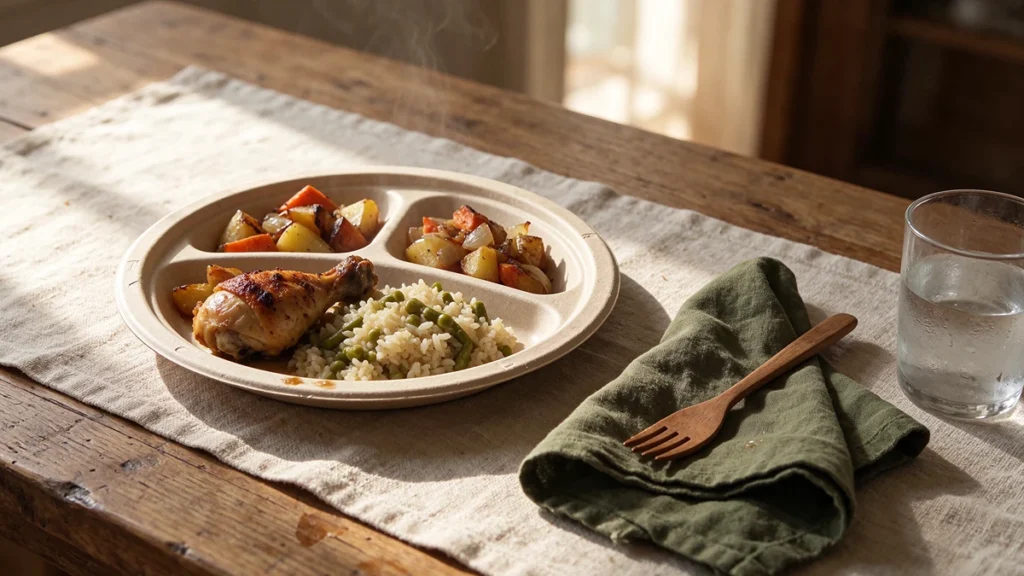
Choose bagasse tableware for catering from four inputs: the dish, the headcount, the service style, and the destination market. Plan 1.5 plates per guest plus a 10–15% buffer. Then confirm two papers before you order: an industrial compostability certificate for the finished article, and food-contact compliance valid in the market you ship to.
Most catering buyers start with a catalogue. That’s the wrong end.
A plate that sells well in a café can buckle under a two-hour buffet line, in front of fifty guests. We’ve seen enough of these go wrong to turn the brief into a form: dish, headcount, service style, market, order size. Five fields, and most of the bad matches eliminate themselves.
Key facts
- Bagasse tableware is moulded fibre from the sugarcane residue left after juice extraction, with no plastic lining.
- Hot-pressed grades are commonly rated to 100 °C water and 120 °C oil, hold water for about 24 hours, and take 3 minutes in a microwave.
- Industrial composting runs 90–180 days. Most catering grades aren’t home compostable.
- Plan 1.5 plates per guest, plus a 10–15% buffer.
- Packing is 250–1,000 pieces per carton, lead time 15–25 days, MOQ 5,000–20,000 pieces once you add print.
- Certification follows the market: BPI and ASTM D6400 in the US, EN 13432 in the EU, AS 4736 in Australia.
What makes catering different from a café brief?
Three inputs fix the specification: the menu, the guest count, and the service style. Change one and the right product changes with it.
Catering orders don’t behave like café orders. Volumes are large, the service window is fixed, and the client watches every plate.
- A buffet has to hold a curry for two hours without going soft.
- A wedding needs a rim that photographs well.
Two rule changes pushed buyers here:
- EU single-use plastics directive. Expanded polystyrene food containers came off the menu across member states in 2021.
- US state PFAS laws. A growing list now restricts intentionally added PFAS in food packaging.
Restaurant groups, foodservice operators, wedding caterers and event venues moved into bagasse tableware for the same rule, and each of them writes the spec differently.
Bagasse is the fibre left after sugarcane is crushed for juice. It’s pressed with heat and pressure, no coating, which is why the finished article takes hot food without a liner. For the material story, see what bagasse actually is or how bagasse tableware is made.
Which format fits which service style?
Match the format to how food is held and moved, not to the cheapest line on the price sheet.
Table 1. Service-style decision table
| Service style | Typical guest count | Menu profile | Format to quote | Units per guest |
|---|---|---|---|---|
| Buffet / self-serve | 50–500 | Mixed, shared, sauces | 9–10 in 3-compartment plate plus a bowl | 1 plate, 1 bowl if soup is served |
| Plated sit-down | 20–300 | Single portion, plated | 9 in round plate, lid optional | 1 plate |
| Event takeaway | 50–1,000 | Sauced, mobile, stacked | Clamshell container with lid | 1 container |
| High-volume / QSR | 200+ | Fast turn, repeated items | Stackable plate | 1.5 plates including buffer |
Scope: catering and event contexts. Guest bands are typical ranges, so scale them to the venue rather than treating them as capacity limits.
Each style stresses the product differently:
- Buffet / self-serve: compartment plates earn their cost here. Sauce stays in its well, re-clearing drops and the handover is cleaner.
- Plated sit-down: a rim and weight question. Two bagasse tableware plates of the same diameter can differ by 8 g per piece, and that gap decides whether the plate flexes one-handed.
- Takeaway / high-volume: stacking. A plate that releases cleanly saves seconds per order, and those seconds are the queue.
How many plates do you need per guest?
One formula, used every time: plates = guests × plates per guest × (1 + buffer).
Published wholesale guidance works to about 1.5 plates per guest, with a 10–15% buffer. The buffer covers breakage, second helpings, and the guests who didn’t RSVP.
Table 2. Quantity planning examples
| Guests | Base plates / guest | Buffer | Total to order |
|---|---|---|---|
| 50 | 1.5 | 10–15% | 83–87 |
| 100 | 1.5 | 10–15% | 165–173 |
| 200 | 1.5 | 10–15% | 330–345 |
| 300 | 1.5 | 12% | 504 |
In practice: a 300-guest buffet
Two mains and a soup station, worked out:
- Mains: 300 × 1.5 = 450, plus 12% = 504. Order 500 three-compartment plates at 9 inches.
- Soup: one bowl per guest, so 300 bowls.
- Sides: 300 plates at 7 inches, doubled to 600 if the venue has no dishwasher.
Buyers scale the mains and forget the sides. The shortfall lands on the event day, when nobody can reorder in time.
How do you match a format to the menu?
Start with the dish, not the catalogue, and match to the worst case on the menu. If the buffet has a curry, you’re specifying for the curry.
Table 3. Menu-to-format matching matrix
| Dish condition | Tolerance | Hold / resistance | Format | Pass threshold |
|---|---|---|---|---|
| Hot, dry | 100 °C water | 2–4 h | Flat plate | Holds serving temperature without softening |
| Fried / oily | 120 °C oil | 2–4 h | Heavy-duty plate | No oil strike-through inside the service window |
| Sauced / wet | 100 °C | \~24 h water resistance | 3-compartment plate or clamshell | No strike-through at the 2-hour mark |
| Cold / frozen | −20 °C | Not applicable | Flat plate or bowl | No deformation after thaw |
Source: published bagasse product specifications. Hot-pressed grades are rated to 100 °C water and 120 °C oil, with roughly 24-hour water resistance and microwave use up to 3 minutes. Values vary by grade and wall thickness. Pass thresholds are buyer-side acceptance criteria, not product guarantees.
Set one number per dish type and hold suppliers to it. A plate either holds 100 °C water for two hours or it doesn’t, and you want that answer from a sample, not from the venue at 7 p.m.
What size and compartment options should you check?
Size is a fit question: the plate holds the portion with 10–15 mm of clear edge, or the guest carries food to the table.
Table 4. Size and compartment reference
| Dish type | Diameter | Compartments | Capacity | Selection rule |
|---|---|---|---|---|
| Main course | 225 mm / 9 in | 1 | Not stated | Diameter ≥ plate footprint + 10 mm margin |
| Buffet split | 225–254 mm / 9–10 in | 3 | Not stated | Main well holds the staple portion |
| Side / salad | 152–178 mm / 6–7 in | 1 | Not stated | Holds one serving without overflow |
| Sauce cup | 60–120 mm | 1 | 60–120 ml | Holds one sauce serving, lid required |
Source: published bagasse product ranges. Round plates run 6–12 inches and standard wall thickness is 2.0–3.5 mm, so recheck dimensions at order time.
Two numbers belong in the brief, and buyers usually write only the first:
- Diameter, with the edge margin it leaves on the food.
- Unit weight, which most spec sheets leave out.
Two plates of the same diameter can differ by 8 g, and that gap decides how the plate behaves under a heavy portion. Put both numbers in the brief and a supplier can’t quietly substitute a lighter mould.
Compartment count follows the number of components that must stay apart. Two sauces and a main means three wells.
Which performance checks matter before you order?
Three tests cover most catering failures: heat hold, leak hold, and stack load. Ask for the report rather than the assurance, and keep the conditions each result was run under.
Heat and leak are one measurement taken twice. Hot-pressed grades tolerate about 100 °C water and 120 °C oil, resist water for roughly 24 hours, and take three minutes in a microwave. Those figures set the menu ceiling: a dish above it needs another format or a liner, and no handling discipline fixes that.
Stack strength is the transport question. Ask for four numbers:
- Stack height before the pile starts to lean.
- The load at which plates deform.
- Wet-burst value on a loaded stack.
- Freezer performance at −20 °C, where cheap moulds come back warped.

Which certifications apply to your market?
Certification follows the destination market and the standard edition. A certificate that satisfies a buyer in Hamburg won’t satisfy one in Houston.
Table 5. Certification and compliance matrix
| Certification / standard | Threshold | Environment | Market | Applies to |
|---|---|---|---|---|
| BPI | 90% within 180 days | Industrial | US, Canada | Finished article |
| ASTM D6400 | 90% within 180 days | Industrial | US | Article or resin |
| ASTM D6868 | 90% within 180 days | Industrial | US | Paper and coatings |
| EN 13432 | 90% within 6 months | Industrial | EU | Article and packaging |
| TÜV OK Compost INDUSTRIAL | 90% within 180 days | Industrial | EU, international | Finished article |
| TÜV OK Compost HOME | 90% within 12 months | Home | EU, international | Finished article |
| AS 4736 | 90% within 180 days | Industrial | Australia | Finished article |
| FDA 21 CFR 176.170 | Migration limits | Not applicable | US | Paper components in contact with food |
| LFGB | Migration limits | Not applicable | Germany, EU | Article and material |
| ISO 18606 | Organic recycling | Organic recycling | International | Packaging |
Source: published texts from BPI, ASTM, CEN, TÜV Austria, the FDA, LFGB and ISO. Confirm thresholds and editions against the current official text; this table is a buyer framework, not a compliance opinion.
Three things to check on any certificate you’re handed:
- The standard and its edition.
- The composting environment, industrial or home.
- Whether the scope names the finished article or only the raw fibre.
A fibre-level certificate pasted into a product listing is the commonest gap we see in buyer files.
Verification is free: the BPI directory covers North America, and TÜV Austria’s database covers OK Compost claims. If the number doesn’t come up, the claim doesn’t exist.
PFAS and additive documentation
Ask for a written PFAS-free declaration plus a third-party test behind it. Procurement specs increasingly set total organic fluorine below 50 ppm per lot, and several US states now restrict intentionally added PFAS. The words “PFAS-free” in a listing protect nothing.
For the terminology, see biobased, biodegradable and compostable.
Is bagasse home compostable or industrial only?
Most bagasse tableware is built for industrial composting, where controlled heat and moisture break it down in 90–180 days. Home composting is a different claim under a different standard, with a longer cycle at lower temperatures.
Keep the article separate from the material. A coating, ink or additive can change the result.
- The certificate has to name what you’re buying, not the fibre it came from.
- Two suppliers can both sell “compostable bagasse plates” and hold certificates for different things.
If you plan a home-compostable claim on retail packaging, budget for the test first. It’s cheap to make and expensive to defend.
What changes with custom print or private label?
A printed plate is the cheapest branded surface at a catered event: every guest holds one for twenty minutes, and half of them photograph it.
Three things change with print:
- Printable area eats usable food surface. A 9-inch plate with a 15 mm band behaves like an 8.5-inch one.
- Ink has to be food-contact approved for the article, not just for paper.
- Certificate scope can shift, so the printed version may need its own paperwork.
Cost moves too. Embossed tooling carries a one-off mould charge, and print lifts MOQ from stock levels into the 10,000-piece range.
How do cartons, stacking and storage affect cost?
Bulk bagasse tableware pricing works by carton, so the carton is the unit that decides your landed cost.
Table 6. Bulk logistics reference ranges
| Parameter | Reference range | Unit | What to do with it |
|---|---|---|---|
| Units per carton | 250–1,000 | pieces | Match against your packing list |
| Carton volume | 0.02–0.07 | m³ | Feed the freight quote |
| Stack layers | 5–8 | layers | Don’t exceed the package rating |
| Storage humidity | Under 65 | % RH | Keep fibre below 10% moisture |
| Lead time | 15–25 | days | Book against the event date |
Source: published bagasse packing lists, carton dimensions and production lead times. Values vary by SKU and destination.
A higher carton count per unit usually lowers shipping volume and storage footprint. The saving rarely shows in the unit price and always shows in the landed cost.
What drives price and MOQ?
Five inputs set the price: fibre, format and size, print, certification, and freight. MOQ moves with customization, so a printed run carries a higher minimum than a stock item.
Table 7. Indicative FOB ranges, standard formats
| Format | Indicative FOB range | Note |
|---|---|---|
| 9 in plate | \$0.03–0.14 | Falls with volume |
| 16 oz bowl | \$0.04–0.15 | Lid quoted separately |
| Three-section tray | \$0.05–0.25 | Compartment count drives tooling cost |
Source: published wholesale price guides. Distributor pricing typically runs 40–70% above factory-direct.
Say FOB or CIF when you request the quote. The two aren’t comparable, and a 15% gap between them is normal rather than suspicious.
How do you verify a supplier before ordering?
Run the same five checks on every candidate and keep the answers in one file. That file is what makes the second order faster than the first.
- Match the certificate to the market. Confirm the finished article is certified to the standard your destination recognises, then look the number up in the issuing body’s database.
- Ask for test reports, not letters. Heat, oil, migration and PFAS results, each with the conditions it was run under.
- Recheck the specification and the quantity. Size, compartment count, unit weight, and the formula from Section 3.
- Get a written quotation with named shipping terms. Published ranges are a starting point, not a price.
- Approve a sample and book the production window. Write the lead time against your event date before you pay.
A supplier who sends a logo instead of a certificate number is telling you something.
Conclusion
Most failed orders we see start the same way. A buyer picks a plate from a catalogue, then finds out the buffet runs two hours and the plate has already gone soft.
Working backwards from the dish is faster. Fill in headcount, service style and market, and the shortlist keeps shrinking. Our default is 1.5 plates per guest plus a 10–15% buffer.
Two papers close it out: an industrial compostability certificate that names the finished article, and food-contact approval valid in your market. Everything else here is detail you can look up when you need it.
FAQs
Are bagasse plates good for hot catering food?
Yes, within the published tolerances: about 100 °C for water-based dishes and 120 °C for oil. Check the serving temperature of your hottest dish against the grade you’re buying.
How many plates should I order per guest?
About 1.5 plates per guest plus a 10–15% buffer. A 300-guest buffet works out to roughly 500 plates once the buffer is applied.
Do bagasse plates leak with saucy dishes?
Leak resistance is a hold time rather than a yes-or-no property. Quality grades hold water for roughly 24 hours, which covers a two-hour service window.
What's the MOQ for custom bagasse tableware?
Custom and private-label runs commonly land between 5,000 and 20,000 pieces per design. Custom print often starts around 10,000 pieces, with embossed tooling charged separately.
Can bagasse tableware go in a home compost bin?
Most of it can’t. Catering grades are certified for industrial composting, 90–180 days under controlled conditions. Home compostability needs a separate certificate on the finished article.
Let's discuss your product requirements.
Share your product brief, estimated quantity and target timeline with WVSCM.
Request a Quote