

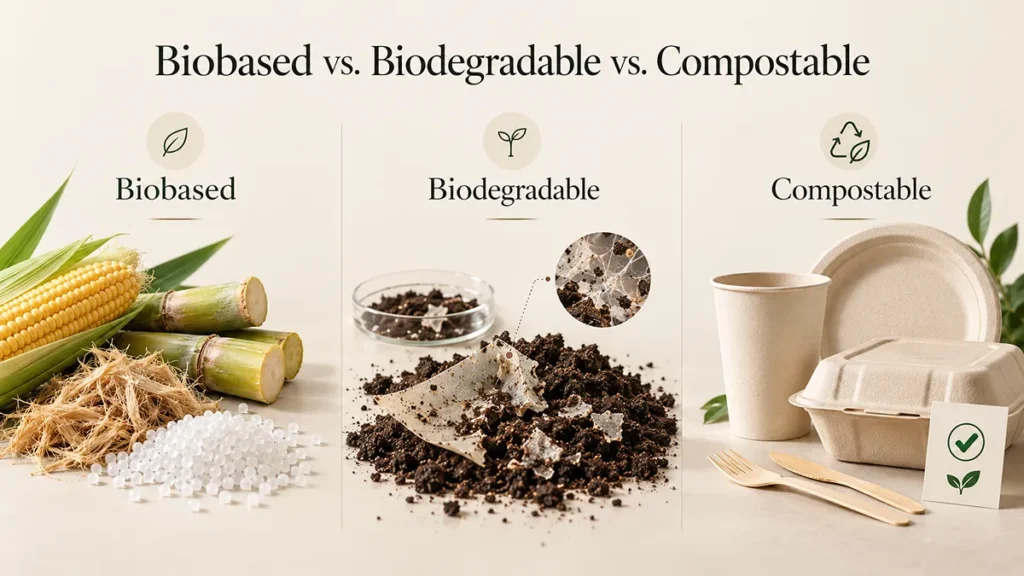
Biobased, biodegradable, and compostable are common terms in sustainable packaging and product sourcing. Although they are often used together, they describe different material properties. A product made from plant-based materials is not necessarily biodegradable, and a biodegradable product does not automatically meet compostability requirements.
For brands, retailers, and distributors, understanding these differences is essential when evaluating products such as dog poop bags, pet wipes, and bagasse tableware. The right choice depends on material composition, product performance, supporting documentation, and the intended end-of-life process.
This guide explains how the three terms differ, what buyers should verify, and how to evaluate environmental claims before placing an order.
Key Takeaways
- Biobased describes the origin of a material, not how it behaves after use.
- Biodegradable describes the ability of a material to break down through biological processes under suitable conditions.
- Compostable refers to products that meet defined requirements for breakdown under specified composting conditions.
- Material origin alone does not establish biodegradability or compostability.
- Buyers should verify product-specific documentation, certification scope, and local disposal requirements before accepting environmental claims.
What Does Biobased Mean?
Biobased materials are made wholly or partly from biological resources, such as plants and agricultural feedstocks. The term describes where a material comes from, rather than how it breaks down after disposal.
Biobased content can vary between products. Some contain a high proportion of biological material, while others combine biological and fossil-based ingredients.
Are Biobased Materials Always Biodegradable?
No. Biobased and biodegradable describe different properties.
A biobased plastic may be designed for durability and may not biodegrade under ordinary environmental conditions. Conversely, some biodegradable plastics are made from fossil-based feedstocks.
When evaluating a biobased product, buyers should check:
- The verified percentage of biobased content.
- Whether the evidence applies to the material or finished product.
- Whether separate biodegradability or compostability claims are supported.
A plant-derived ingredient does not, by itself, establish how the finished product will behave after use.
What Does Biodegradable Mean?
A biodegradable material can be broken down by microorganisms under suitable environmental conditions. The rate and extent of breakdown depend on the material’s composition and the environment in which it is exposed.
The term alone does not specify how quickly a product will degrade or whether degradation will occur in soil, water, a landfill, or a composting facility.
Why Do Environmental Conditions Matter?
Biodegradation depends on factors such as temperature, moisture, oxygen availability, microbial activity, and material composition. Results under controlled testing conditions may not reflect what happens in an uncontrolled disposal environment.
This creates a practical problem for buyers: a product labeled biodegradable may not provide enough information to determine how it should be disposed of.
Before accepting the claim, ask the supplier:
- Under what conditions was the product tested?
- Which testing method or standard was used?
- Does the evidence cover the finished product?
- Are there specific disposal instructions or limitations?
These details make a biodegradability claim more meaningful than the label alone.
What Does Compostable Mean?
Compostable products must meet defined requirements for breaking down under specified composting conditions. Depending on the applicable standard, evaluation may also cover biodegradation, disintegration, and effects on the resulting compost.
Compostability is therefore more specific than a general claim of biodegradability. A product described as biodegradable does not necessarily meet the requirements for composting.
Home Compostable vs. Industrially Compostable
Home and industrial composting operate under different conditions. Industrial facilities typically manage temperature, moisture, and processing more closely, while home composting conditions vary with climate, equipment, and maintenance.
| Factor | Home Composting | Industrial Composting |
|---|---|---|
| Environment | Household composting conditions | Managed commercial facility |
| Temperature | Generally lower and more variable | Typically higher and controlled |
| Processing | Depends on household conditions | Uses managed processing conditions |
| Product suitability | Requires evidence for home composting | Requires evidence for industrial composting |
An industrially compostable product should not automatically be described as home compostable.
Buyers should verify the exact certification, applicable standard, and disposal instructions. They should also confirm that local facilities accept the product, since certification does not guarantee acceptance by every composting program.
Biobased vs. Biodegradable vs. Compostable: Key Differences
The clearest way to distinguish these terms is to ask what each one describes: material origin, biological breakdown, or performance under composting conditions.
| Comparison | Biobased | Biodegradable | Compostable |
|---|---|---|---|
| Main meaning | Material origin | Ability to break down biologically | Ability to meet specified composting requirements |
| Key question | Where does the material come from? | Can it biodegrade under suitable conditions? | Does it meet the relevant composting criteria? |
| Guarantees renewable content? | Indicates biological content; percentage needs verification | No | No |
| Guarantees compostability? | No | No | Only within the scope of the applicable requirements |
| What buyers should check | Biobased content and supporting evidence | Test conditions and degradation evidence | Applicable standard, certification scope, and disposal requirements |
The terms are not interchangeable. A material can be biobased without being biodegradable, or biodegradable without being biobased. Compostability must be assessed against the relevant requirements and conditions.
For businesses comparing biodegradable packaging or compostable packaging, the decision should be based on the intended application, product documentation, and available disposal infrastructure—not simply which label sounds more sustainable.
Real-World Examples: How These Terms Apply to Products
Product examples help show why material claims need to be evaluated separately from performance and disposal requirements.
Example 1: Biobased Dog Poop Bags
WVSCM offers dog poop bag options with 41% and 92% USDA Certified Biobased content. These figures describe the stated biobased content of the respective products; they do not, on their own, establish compostability.
For a brand sourcing dog waste bags, the evaluation should cover material content, bag strength, leak resistance, roll configuration, and the intended environmental claims.
If a supplier also claims that a finished bag is biodegradable or compostable, buyers should request the relevant evidence for that specific product.
Explore WVSCM dog poop bags.
Example 2: Bagasse Tableware
Bagasse is the fibrous material left after sugarcane is processed for juice extraction. It can be molded into plates, bowls, and takeaway containers for foodservice applications.
However, plant-based raw material does not automatically establish that a finished product is compostable. Coatings, additives, and other components may affect whether the product meets a particular standard.
Foodservice buyers should evaluate product performance, food-contact documentation, intended use, and evidence supporting any environmental claims.
Explore WVSCM sustainable tableware.
Example 3: Pet Wipes and Training Pads
WVSCM lists pet wipes with 100% USDA Certified Biobased content and training pads with 48% USDA Certified Biobased content. These figures apply to the respective products and should not be generalized to other products in the same categories.
Neither percentage alone proves that the finished product is biodegradable or compostable. Buyers should verify the relevant documentation before making additional environmental claims.
See the WVSCM pet supplies range.
How to Verify Environmental Claims When Sourcing Products
For brands, retailers, and distributors, understanding the terminology is only the first step. The next is confirming that supplier claims are supported by evidence relevant to the product being purchased.
Check Product-Specific Documentation
Request documentation that identifies the product, material composition, applicable standard, and scope of testing or certification.
A certificate covering a raw material should not automatically be treated as certification of the finished product. Likewise, evidence for one formulation or product model may not cover other sizes, coatings, or configurations.
Confirm Requirements for the Target Market
Requirements vary by product category and destination market. Buyers sourcing products for the United States may need to consider applicable ASTM compostability standards and relevant certification programs. European market requirements may differ.
The US Environmental Protection Agency’s guidance on plastic recycling and composting explains key distinctions between biobased and compostable plastics. The European Commission’s guidance on biobased, biodegradable, and compostable plastics provides further context on material claims and end-of-life considerations.
Use these resources as starting points, then verify the requirements applicable to the actual product and market.
Check Local Disposal Options
A certified compostable product may still be unsuitable for a particular disposal route if local facilities do not accept it.
Before approving product labels or disposal instructions, confirm the intended treatment method and the acceptance requirements of relevant collection programs.
For procurement teams, a practical checklist includes:
- Verified material composition and biobased content, where claimed.
- Product-specific testing and certification documents.
- Clearly defined environmental claims and conditions of use.
- Packaging and labeling requirements for the destination market.
- Disposal guidance consistent with the available facilities.
This process helps buyers compare suppliers on evidence rather than relying on broad sustainability language.
Conclusion
Biobased, biodegradable, and compostable describe different material characteristics. Understanding these differences helps businesses assess products accurately, avoid unsupported claims, and select materials that suit their intended applications.
For sustainable tableware and pet supplies, purchasing decisions should consider product performance, verified material information, applicable documentation, and realistic end-of-life options.
FAQs
Is Biobased Plastic Always Biodegradable?
No. Biobased describes the origin of a material, while biodegradable describes its ability to break down biologically under suitable conditions. A biobased plastic may behave like conventional plastic, so biodegradability must be verified separately.
Is Biodegradable the Same as Compostable?
No. Compostable products must meet defined requirements under specified composting conditions. A biodegradable product does not necessarily meet those requirements or suit every composting system.
Are All Biobased Plastics Compostable?
No. Some biobased plastics are designed for durability and may not biodegrade under composting conditions. Buyers should check the finished product’s documentation rather than infer compostability from its raw material source.
What Is the Difference Between Home and Industrial Composting?
Home composting takes place under variable household conditions, while industrial composting generally uses managed processing conditions. Product certification and instructions should specify the environment for which the product is suitable.
How Can Buyers Verify Compostable Packaging Claims?
Check product-specific certification or test documentation, the applicable standard, and the scope of the evidence. Confirm that the documents cover the finished product and that local composting facilities accept it.
Is Bagasse Tableware Automatically Compostable?
Not automatically. Bagasse is a plant-derived material, but the finished product’s composition, coatings, additives, and applicable requirements determine whether a compostability claim is supported. Verify the relevant documentation before making the claim.
Let's discuss your product requirements.
Share your product brief, estimated quantity and target timeline with WVSCM.
Request a Quote