

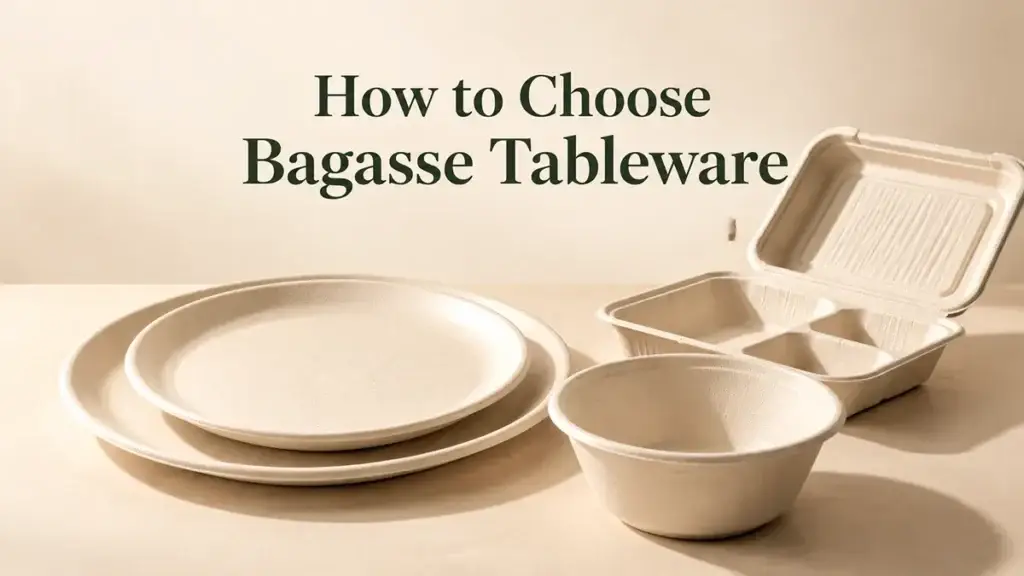
Choosing bagasse tableware involves more than selecting a material. Product dimensions, structural strength, grease resistance, packaging, and supply consistency all affect how well a product performs in a foodservice operation.
Even compostable tableware may not perform as expected if its specifications do not match the intended application. A plate designed for light meals, for example, may not provide the support needed for heavier portions or prolonged contact with hot, oily foods.
For restaurants, caterers, distributors, and private-label brands, selecting the right product means balancing serving requirements, product documentation, purchasing costs, and delivery needs.
This guide explains how to choose bagasse tableware for foodservice, what specifications to verify, and what buyers should confirm before placing a bulk order.
Key Takeaways
- Match product formats and dimensions to food type, portion size, serving conditions, and delivery requirements.
- Evaluate structural strength, grease resistance, and moisture performance using product-specific information and sample testing.
- Verify food-contact documentation and compostability claims against the requirements of the destination market.
- Confirm specifications, packaging, minimum order quantities, and lead times before approving a bulk order.
- For wholesale or custom orders, establish clear product requirements and quality expectations before production.
What to Consider Before Choosing Bagasse Tableware
Before requesting quotations, define how the tableware will be used. Clear requirements help narrow the product options and make supplier quotations easier to compare.
Food Type and Serving Conditions
Start with the food the tableware needs to hold and how long it will remain in the container.
Dry foods, fried items, hot meals with sauces, and dishes containing liquids place different demands on disposable tableware. Takeaway operations also need to consider holding time, transport conditions, and whether containers may be tilted, stacked, or compressed during delivery.
Before selecting a product, identify:
- The food type, portion weight, and expected holding time.
- The serving temperature and the food’s oil and moisture content.
- Whether compartments or compatible lids are required.
- Whether the product will be used for takeaway, delivery, catering, or high-volume service.
These details provide a more practical basis for product selection than relying on general descriptions such as durable, sustainable, or suitable for all foods.
Product Dimensions and Serving Capacity
Product dimensions should match the intended portion and serving method. For plates, check the diameter, usable serving area, and compartment design. For bowls and containers, verify depth, usable capacity, and internal structure.
For takeaway operations, confirm that the selected product fits existing packaging, delivery bags, and storage arrangements. If lids are required, verify compatibility with the exact product model rather than assuming similar-looking items will fit.
Structural Strength and Grease Resistance
Bagasse tableware is molded into specific shapes, but thickness, weight, edge design, and manufacturing quality can vary between products. These differences may affect structural performance. Material characteristics and surface treatments can also influence grease and moisture resistance.
For products intended to hold heavier meals, oily foods, or dishes with sauces, review the available specifications and test samples before making a purchasing decision.
When performance is critical, agree on the testing conditions and acceptance criteria with the supplier. This is more useful than relying on broad claims such as leak-resistant or heavy-duty without supporting product information.
Which Bagasse Tableware Format Fits Your Business?
Product selection should start with the intended foodservice application, followed by a comparison of suitable sizes, structures, and performance requirements.
Sugarcane Bagasse Plates
Sugarcane bagasse plates are available in different diameters and molded designs, including compartment formats. They can be considered for catering, takeaway meals, and other foodservice applications, depending on the specifications of the individual product.
When comparing sugarcane bagasse plates with conventional paper or plastic alternatives, buyers should consider serving requirements, structural performance, and intended use rather than material alone.
Key selection factors include:
- Diameter and serving area: Whether the plate accommodates the intended portion and food arrangement.
- Structural design: Whether compartments are needed and whether the rim and base suit the application.
- Load performance: Whether the plate bends or deforms when holding a representative meal.
- Stacking and packaging: Whether the product can be stored, handled, and distributed efficiently.
For high-volume foodservice, consistent dimensions and practical carton packaging are also important because they affect storage, inventory management, and daily handling.
Bagasse Bowls
Bagasse bowls are suitable for foods that require a deeper serving format, including salads, rice dishes, and other prepared meals.
Selection should be based on usable capacity, depth, rim design, and intended use. For bowls holding hot foods, sauces, or liquids, verify the product’s suitability under the expected serving conditions.
If lids are required, confirm that they fit the specific bowl model. A compatible bowl-and-lid combination can simplify packaging and handling in takeaway and delivery operations.
Molded-Fiber Takeaway Containers
Takeaway containers must accommodate the food while remaining suitable for packing, stacking, and transport.
Depending on the application, buyers should evaluate compartment layout, closure design, packaging dimensions, and stability during handling. Test the container with representative meals to check whether it closes securely, deforms under normal use, or creates difficulties during delivery.
The right product is the one that meets the actual requirements of the operation, not necessarily the one with the most features.
How to Check Bagasse Tableware Specifications
Prepare a consistent specification checklist before requesting quotations. This helps suppliers quote against comparable requirements and reduces misunderstandings during production and delivery.
| Specification | What to Verify |
|---|---|
| Product dimensions | Diameter, length, width, height, or depth |
| Capacity | Usable volume for bowls and containers |
| Unit weight | Confirmed product weight and agreed tolerance |
| Structural design | Shape, compartments, rim design, and intended use |
| Performance requirements | Relevant strength, grease resistance, moisture resistance, and temperature information |
| Packaging | Pieces per pack, pieces per carton, and carton dimensions |
| Product documentation | Applicable test reports, compliance documents, and supporting records |
Not every specification applies to every product. Plate selection often focuses on diameter and compartment design, while bowls and containers require closer attention to capacity and depth.
For specifications that affect product performance or repeat orders, confirm the actual values and acceptable tolerances before approving the order. For customized products, verify that the final production specifications match the approved sample.
What Compliance Documents Should Buyers Check?
Compliance requirements depend on the product, intended use, and destination market. Buyers should verify the documents relevant to the actual product rather than relying on general certificates or supplier statements.
Check the Scope of Food-Contact Documentation
Request applicable food-contact compliance documents or test reports for the intended market. Check the product model, material, testing scope, issuing organization, and stated conditions of use.
A report covering one material or product model should not automatically be treated as evidence for an entire product range. If the product specification changes, confirm whether the existing documentation remains applicable.
Understand What FDA and LFGB Requirements Mean
For products supplied to the US market, applicable FDA food-contact requirements may need to be considered. For certain European market applications, buyers may request testing against relevant German LFGB food-contact requirements.
These references are not interchangeable with universal product certifications. FDA food-contact compliance depends on the applicable regulatory requirements and conditions of use, while LFGB-related testing should be assessed according to its specific scope.
Buyers should verify the requirements for the destination market and intended application rather than assuming that a single report establishes compliance for every use.
Verify Compostability and Environmental Claims
If compostability is a purchasing requirement, verify the applicable certification for the finished product, including its scope and conditions.
BPI certification is associated with specific compostability requirements in North America, while EN 13432 addresses the requirements for packaging recoverable through composting and biodegradation. Neither should be treated as a substitute for food-contact documentation.
Industrial compostability and home compostability are also different claims, and local waste-processing facilities may have different acceptance requirements.
A product’s bagasse content alone does not establish that it is suitable for every composting or waste-management system. Before describing a product as compostable tableware, confirm that the claim is supported by documentation for the finished product.
How to Test Bagasse Tableware Samples Before Ordering
Sample testing should establish whether a product meets the actual requirements of the application, not simply whether it appears to be of good quality. Use real foods and conditions that closely reflect normal operations.
- Test with representative foods. Use typical menu items and portion sizes rather than judging load performance with empty tableware.
- Check structural stability. Observe whether the product bends, deforms, or provides insufficient support when filled.
- Evaluate grease and moisture resistance. During the expected holding period, check for softening, leakage, or loss of shape.
- Simulate handling and delivery. For takeaway containers, check closure, stacking, and performance during normal handling and transport.
- Record the test results. Document the test conditions, observations, and any issues that need to be resolved before approval.
If microwave use is required, confirm that the specific product is approved for microwave heating. Check the manufacturer’s instructions, applicable temperature limits, permitted heating duration, and any restrictions related to food type or use conditions. Do not assume that all bagasse tableware is microwave-safe simply because it is made from plant fiber.
Once approved, keep a reference sample for checking product consistency.
What to Confirm Before Placing a Bulk Order
Passing sample evaluation does not settle every commercial or logistical requirement. Before confirming a bulk order, review the following details.
Minimum Order Quantity and Order Volume
Confirm the minimum order quantity (MOQ), order multiples, and pieces per carton. If several SKUs or sizes are required, check whether the supplier can accommodate the product mix and whether separate minimums apply to individual items.
Packaging and Total Delivered Cost
Compare quotations using equivalent product specifications and packaging quantities. In addition to unit price, consider:
- Pieces per carton and outer carton dimensions.
- Shipping volume and associated freight costs.
- The effect of packaging on storage and transportation.
- Other applicable delivery charges.
A lower unit price does not necessarily mean a lower overall purchasing cost. Evaluating the complete order provides a more accurate basis for comparison.
Lead Time and Repeat-Order Consistency
Confirm production lead time, shipping arrangements, and the communication process for delays, specification changes, or quality issues.
For repeat orders, use the approved sample and written specifications as quality benchmarks. Confirm that subsequent shipments meet the agreed requirements, and establish how proposed product or packaging changes will be communicated.
These checks help buyers manage supply expectations and reduce avoidable discrepancies between approved samples and delivered orders.
How to Choose a Bagasse Tableware Supplier
Supplier evaluation should go beyond the quoted price. Clear product information, relevant documentation, and reliable order communication all contribute to a successful purchasing relationship.
Evaluate potential suppliers based on the following criteria:
- Specification transparency: Can the supplier clearly document dimensions, weight, packaging quantities, and relevant performance information?
- Documentation support: Can the supplier provide applicable records for the specific product and destination market?
- Sample approval: Can samples be evaluated before a bulk commitment, with agreed specifications recorded?
- Customization support: Can the supplier coordinate available product, packaging, or private-label requirements?
- Delivery coordination: Are MOQ, lead time, shipping arrangements, and repeat-order requirements clearly communicated?
For businesses sourcing wholesale bagasse tableware, these checks help establish whether a supplier can meet the required order volume and delivery schedule.
For custom bagasse tableware projects, buyers should also confirm available customization options, artwork and packaging requirements, approval procedures, and any additional lead time associated with customized production.
Conclusion
The right bagasse tableware should meet the practical demands of the menu, serving method, and purchasing program. Clear specifications and verified product documentation provide a stronger basis for supplier comparisons than material claims or unit price alone.
For businesses sourcing wholesale bagasse tableware or developing custom bagasse tableware, confirming product requirements, packaging details, and delivery expectations early can help establish a more reliable supply process.
FAQs
How Do You Choose the Right Bagasse Plate Size?
Choose plate size according to portion size, food presentation, and serving requirements. Verify the actual diameter and usable serving area, then test a sample with a representative meal before placing a bulk order.
Are Bagasse Plates Suitable for Hot and Greasy Foods?
Suitability depends on the specific product’s construction and performance. Review the manufacturer’s instructions and test samples with the intended foods, temperatures, and holding times before approving the product.
What Documents Should a Bagasse Tableware Supplier Provide?
Depending on the product and destination market, buyers may need applicable food-contact documentation, test reports, and evidence supporting environmental claims. Verify that each document covers the specific product and intended application.
Is All Bagasse Tableware Microwave-Safe?
No. Microwave suitability depends on the specific product and its manufacturer’s instructions. Confirm permitted heating conditions, temperature limits, and any restrictions before using the product in a microwave.
What Should Buyers Test Before Placing a Bulk Order?
Test samples with representative foods under realistic operating conditions. Check structural stability, grease and moisture resistance, packaging, and handling before approving the product for bulk purchasing.
Let's discuss your product requirements.
Share your product brief, estimated quantity and target timeline with WVSCM.
Request a Quote