



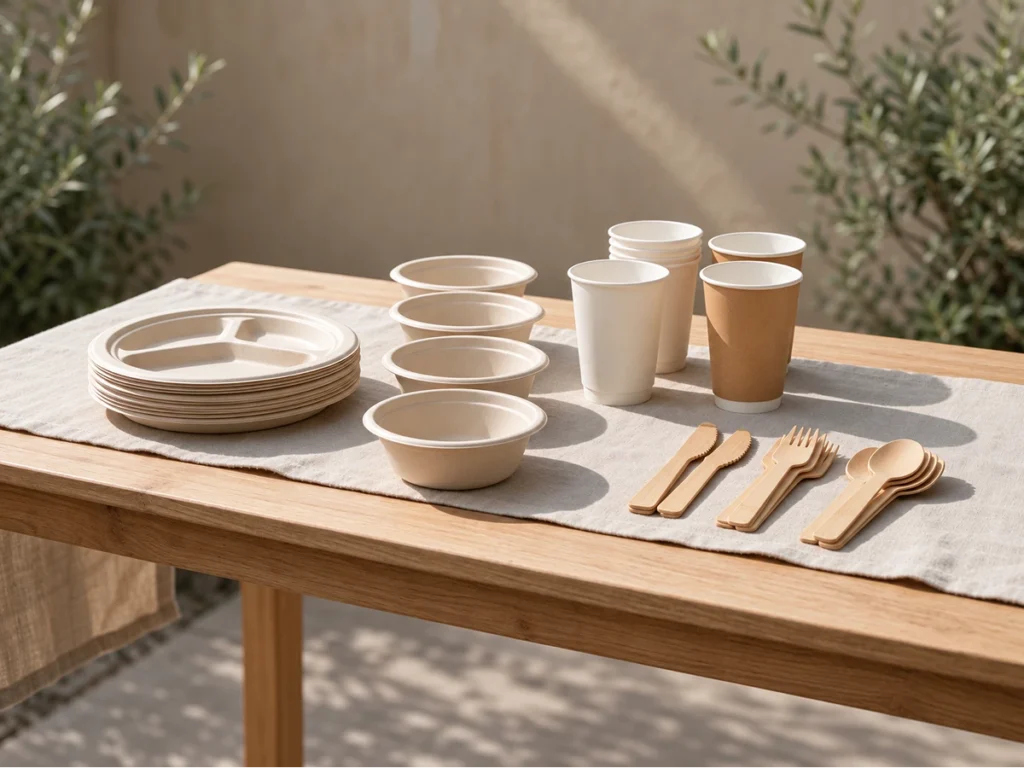
Disposable tableware for catering includes plates, bowls, cups, cutlery, and food containers used for buffets, corporate events, weddings, and takeaway services. The right products depend on the menu, serving format, food-contact requirements, and expected usage.
For catering businesses, wholesalers, and private-label buyers, selecting suitable tableware involves more than comparing prices. Material performance, product specifications, packaging, order quantities, and supplier reliability all affect purchasing decisions. This guide covers the key factors to consider when comparing materials, planning quantities, and sourcing disposable catering tableware in bulk.
Key Takeaways
- Match tableware to the menu, portion size, and service format.
- Compare material, dimensions, unit weight, and performance under intended conditions.
- Calculate quantities using guest count, service rounds, and supplier pack sizes.
- Check food-contact documents and environmental claims for the finished product.
- Evaluate suppliers on MOQ, samples, quality controls, packaging, and delivery.
What Tableware Do Catering Businesses Need?
Disposable catering tableware includes plates, bowls, cups, cutlery, serving trays, and food containers. Each category serves a different purpose, so buyers should select products based on the menu, portion size, and service format.
Plates and Serving Platters
- Dinner plates: For main courses and individual meals.
- Appetizer and dessert plates: For smaller portions and separate courses.
- Compartment plates: For serving multiple foods separately.
- Serving platters: For shared dishes and buffet presentations.
Compare plate diameter, usable surface area, weight, and structure. A larger plate offers more serving space, but size alone does not establish strength.
Bowls, Cups, and Cutlery
- Bowls: Used for salads, soups, rice, side dishes, and desserts. Match capacity and depth to the portion.
- Cups: Available in different capacities and constructions, including single-wall and double-wall paper cups.
- Cutlery: Usually includes forks, spoons, and knives. Check length, strength, finish, and ease of handling.
Food Containers and Serving Accessories
- Clamshell containers and compartment meal boxes for boxed meals.
- Takeout bowls and portion containers for delivery and takeaway.
- Food trays for preparation, display, or serving.
For containers, check lid compatibility, usable capacity, stackability, and suitability for expected transport conditions.
| Product category | Common products | Typical use | Key purchasing factors |
|---|---|---|---|
| Plates | Dinner, dessert, compartment plates | Individual meals | Diameter, structure |
| Bowls | Salad, soup, food bowls | Liquid and solid foods | Capacity, depth |
| Cups | Hot- and cold-beverage cups | Beverage service | Capacity, construction |
| Cutlery | Forks, spoons, knives | Individual dining | Strength, dimensions |
| Platters | Round and rectangular trays | Buffets, shared dishes | Serving area |
| Food containers | Clamshells, meal boxes | Takeaway, delivery | Lid fit, stackability |
A suitable catering assortment should cover actual serving requirements without adding unnecessary products or packaging.

How Does the Catering Format Affect Tableware Selection?
The service format determines how tableware is distributed, carried, and used. Build the product list around the event rather than applying one standard set to every occasion.
- Buffets: Dinner and dessert plates, bowls, platters, cutlery, and cups. Consider how guests carry multiple items and whether plates remain stable with typical portions.
- Corporate and office catering: Individual plates or compartment trays, bowls, cups, and cutlery sets. Consistent packaging supports meal assembly and distribution.
- Drop-off and boxed lunches: Compartment containers, compatible lids, takeout bowls, and individually packed cutlery. Confirm lid fit and transport suitability.
- Outdoor and large events: Products that are easy to store, distribute, and collect. Plan waste sorting and local disposal arrangements before the event.
FLIP’s 2025 Economic Trends Report, based on a 2024 survey, reported that 68.9% of respondents served corporate parties and events, 55.6% served outdoor events, and 51.9% served weddings. It also reported that 47.8% had an average event size of 51–100 people. These figures describe the survey sample, not the entire US catering market.
How Should You Match Tableware to the Catering Menu?
Food type affects the serving area, depth, and performance required from disposable tableware. Review samples with representative portions before confirming a bulk order.
- Main courses: Check plate diameter, usable area, rim design, and structure. Test with typical portions rather than relying on size alone.
- Oily foods and sauces: Ask about coatings or surface treatments. Request relevant grease- or moisture-resistance test results where these properties matter.
- Soups and liquid foods: Review bowl capacity, depth, rim construction, and suitability for liquid contact. For delivery, check compatible lids.
- Salads and cold foods: Match bowl capacity to portion size and handling needs.
- Desserts: Smaller plates or bowls can help standardize portions and simplify service.
Material names alone do not establish performance. The finished product and its intended conditions of use should guide the selection.
Which Materials Are Used for Disposable Catering Tableware?
Bagasse, paper, bamboo, and plastic are common material options. No single material suits every product or use. Compare the finished item, including its construction, coatings, and disposal requirements.
| Material | Common products | What to compare |
|---|---|---|
| Bagasse | Plates, bowls, trays, food containers | Weight, structure, surface finish, coatings, grease and moisture performance |
| Bamboo | Forks, spoons, knives | Dimensions, smoothness, strength, finish, packaging |
| Paper | Plates, bowls, cups, containers | Coating, rigidity, beverage or food application |
| Plastic | Plates, cups, cutlery, containers, lids | Polymer type, thickness, design, market restrictions |
- Bagasse: Sugarcane fiber residue can be molded into plates, bowls, trays, and food containers. Verify performance for the specific finished product.
- Bamboo: Often used for disposable cutlery. Bamboo origin alone does not establish compostability.
- Paper: Coatings and construction affect rigidity and food-contact suitability. Double-wall cups add an insulating layer compared with single-wall designs.
- Plastic: Performance depends on polymer type, thickness, and design. Check restrictions and disposal options in the target market.
Sustainability also depends on local infrastructure. The US Environmental Protection Agency (EPA) identifies reusable food service ware as the preferred option where an effective collection, washing, and return system is available. Certified commercially compostable or recyclable products may be considered when local facilities accept them. Certification alone does not guarantee local acceptance.
For a more detailed comparison of construction, durability, grease resistance, and purchasing costs, see our guide to bagasse vs. paper plates.
Which Product Specifications Should Buyers Check?
Request a product specification sheet and compare suppliers using consistent units and test conditions. Focus on measurable details:
- Plate diameter — mm or inches: Indicates serving area and portion fit.
- Bowl capacity — mL or oz: Indicates usable food volume.
- Unit weight — g per piece: Helps compare material usage when considered with dimensions.
- Thickness and depth — mm: Describe construction and product geometry.
- Carton quantity — pieces per carton: Supports order, storage, and freight planning.
- Surface treatment: Identifies coatings or additives relevant to food contact and disposal.
Also review performance where relevant:
- Structural strength during normal handling.
- Wet strength after moisture exposure.
- Grease and moisture resistance for the intended foods.
- Heat suitability for the specified temperature and contact conditions.
These properties should be supported by product-specific evidence. Compare like-for-like products; differences in size or construction can make price and performance comparisons misleading.
How Do You Calculate Catering Tableware Quantities and Costs?
Estimate the base requirement from guest count, units used per guest, and service rounds. Then account for extra courses, repeated servings, and replacement needs.
Total quantity = (Guests × Units per guest per round × Service rounds) + Additional quantity
Example: for 150 guests receiving one dinner plate, one bowl, and one cutlery set in a single service round, the base requirement is 150 of each item. Add dessert plates or extra cups only when the menu and service plan require them.
Convert Event Demand into Cartons
- Divide the required number of pieces by the supplier’s pieces-per-carton quantity.
- Round up to the next whole carton.
- Confirm inner-pack quantities and master-carton quantities before ordering.
For example, 150 plates packed 50 per carton require 3 cartons. This is an illustration; confirm actual pack sizes with the supplier.
Compare the Total Cost per Guest
Cost per guest = Total tableware cost ÷ Guest count
Include unit price, carton quantity, MOQ, shipping, handling, storage, and potential product damage. A lower unit price may not mean a lower total purchasing cost.
What Food-Contact Requirements Apply to Disposable Catering Tableware?
In the United States, food-contact suitability depends on materials, additives, intended use, and conditions of use. The FDA regulates food-contact substances under the Federal Food, Drug, and Cosmetic Act. The applicable basis may include a regulation in the Code of Federal Regulations, a Food Contact Notification, or another authorization or exemption.
The appropriate regulatory status depends on the substance and application. Food type, temperature, and contact conditions matter. Authorization for one use does not automatically establish suitability for every food or condition.
Documents Wholesale Buyers Should Request
- Material or composition declaration: Identifies the product’s material makeup.
- Food-contact compliance statement: States the applicable regulatory basis and intended use.
- Laboratory test report: Identifies the tested sample, method, conditions, and results.
- Coating or additive information: Describes surface treatments, where applicable.
- Product specification sheet: Records dimensions, weight, construction, and other agreed parameters.
- Certification records: Confirms the certified product and scope, where relevant.
A test report should correspond to the actual product or a representative sample. Changes to material composition, weight, coating, construction, or intended use may require a review or additional testing. Batch identification and documented quality controls help investigate production variations.
How Should Buyers Assess Sustainability and Disposal Options?
Evaluate environmental claims alongside certification scope and local waste infrastructure. A product described as compostable or recyclable may not be accepted by every facility.
| Option | What to verify | Buyer consideration |
|---|---|---|
| Reusable | Collection, washing, return system | Can the event or operator manage reuse? |
| Commercially compostable | Finished-product certification and facility acceptance | Is a suitable local facility available? |
| Recyclable | Material compatibility and local collection rules | Will the local program accept the item? |
| Other disposable products | Local waste regulations and product instructions | How should the product be collected or disposed of? |
- Check certification for the finished product, not only its raw material.
- Confirm that a local commercial composting facility accepts the specific product category.
- Check local recycling rules before describing a product as recyclable.
- Provide clear sorting instructions for staff and event guests.
For the US market, buyers may encounter BPI Commercial Compostability Certification and standards such as ASTM D6400 or ASTM D6868, where applicable to the product construction. Check the specific product or SKU in the certification directory. The FTC Green Guides address the substantiation and qualification of environmental marketing claims.
Before making environmental claims, it is important to understand the differences between biobased, biodegradable, and compostable products and the requirements associated with each term.
What Should Wholesale Buyers Look for in a Catering Tableware Supplier?
Compare suppliers using the same product specifications, order quantities, and packaging requirements. Ask direct questions before requesting a final quotation.
- MOQ and pricing: Is MOQ calculated per SKU or across the order? Is pricing quoted per piece, pack, or carton?
- Packaging: How many pieces are in each inner pack and master carton? Are mixed orders available?
- Samples: Can you review a production sample before approving the order?
- Customization: Can dimensions, product construction, branding, and packaging be adjusted?
- Quality controls: Are sample approval, inspection criteria, and batch identification documented?
- Lead time and delivery: What are the sample, production, and shipping schedules? Which export and delivery documents are provided?
For OEM and Private-Label Orders
- Approve the product specification and production sample.
- Confirm logo artwork, packaging design, and carton configuration.
- Agree on inspection criteria and batch identification.
- Confirm applicable food-contact documents and certification scope.
- Review whether any material or coating change affects existing test reports.
A documented approval process helps reduce differences between the approved sample and mass production.
Conclusion
The right disposable tableware for catering starts with the menu and service format. Plates, bowls, cups, and cutlery should suit the food being served, while material composition and product specifications determine whether each item is appropriate for its intended use.
For wholesale buyers, packaging, order quantities, food-contact documentation, and supplier consistency also matter. Comparing these details before ordering helps catering businesses and distributors select products that fit their operational and sourcing requirements.
FAQs
What is the best disposable tableware for catering?
The best option depends on the menu, service format, and food-contact requirements. Bagasse plates, paper cups, bamboo cutlery, and suitable food containers serve different purposes. Compare finished-product specifications before selecting an assortment.
What size plates are commonly used for catering?
Plate size depends on the menu, portion, and service style. Main courses usually need more serving area than appetizers or desserts. Confirm diameter, usable area, and structure against actual portions.
How many disposable plates do you need per guest?
Calculate guest count × plates per guest per round × service rounds, then add an event-specific allowance. Include separate plates for additional courses when the menu requires them.
Are bagasse plates suitable for hot and greasy foods?
Suitability depends on the finished product’s composition, construction, surface treatment, and intended conditions. Request product-specific test reports and evaluate samples with representative foods.
Where can businesses buy disposable catering tableware in bulk?
Businesses can source through manufacturers, wholesalers, and foodservice distributors. Compare MOQ, carton quantities, specifications, documentation, customization, samples, and delivery terms.
Let's discuss your product requirements.
Share your product brief, estimated quantity and target timeline with WVSCM.
Request a Quote